“Hey, is this your phone?” a man asked Julie Sygiel ’09 while she was on vacation in Spain. The pockets of her dress were so shallow that her phone had fallen out onto the ground.
Sygiel told The Herald that moments like these demonstrated to her the impracticality of pockets in women’s clothing. “Maybe I just need to take matters into my own hands and design things that I want to wear with pockets, and maybe other people will want to wear them too,” she recalled thinking.
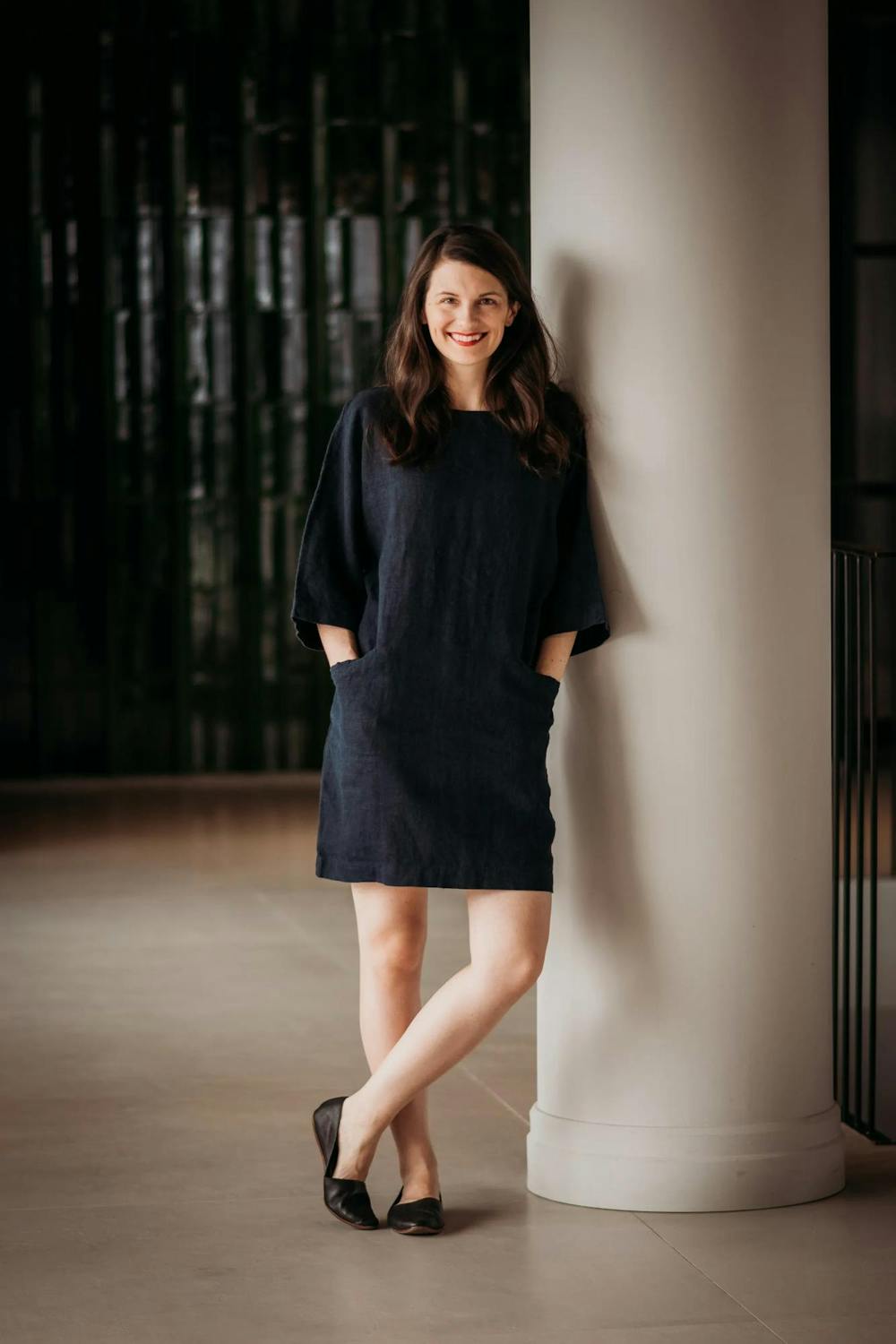
In 2021, Sygiel founded the Pockets Project — an online clothing shop that sells dresses with pockets at least 8.5 inches deep.
The Pockets Project aims to address inequity between men’s and women’s fashion, Sygiel said. After bringing a ruler to Zara and measuring pocket depths on items being sold, Sygiel found that “on average, men’s pockets are three inches deeper than women’s pockets, if we even get them at all,” she wrote in the company’s about page.
The Pockets Project hopes to bridge this gap and give everyone the freedom to carry everything they need to be successful on their person. “Gone are the days when men hold all the valuables,” Sygiel wrote on her website.
Pocket inequity first came to Sygiel’s attention in 2014, she said, when she read an article from The Atlantic written in response to the release of the Apple iPhone 6 and iPhone 6 Plus — larger phone models that were too big to fit in a standard women’s pants pocket.
Sygiel couldn’t stop noticing pocket inequality and began raising the issue to her friends — the first step of starting a business, she says. Their support was the catalyst behind the product. After that, the Spain incident was the cherry on top.
When Sygiel shared her new invention with her friend Lotte Marie Allen, who Sygiel describes as a “pocket devotee,” Allen said that she thought it was the “coolest idea.” “I was like, I need all the dresses with giant pockets,” Allen said.
Sygiel’s next step was to create a survey. She asked over 2,000 survey respondents about their favorite dress fabrics, necklines, colors, lengths and styles. The results of the survey surprised her. “I love a drop waist, but only 6% of the respondents said that they would ever wear a drop waist,” she said.
Taking into account the survey results, Sygiel designed all the dresses by herself and collaborated with a pattern maker and seamstress to create the initial samples.
In October of 2021, Sygiel launched the Pockets Project’s online shop, releasing a collection of five dress styles.
“I don’t anticipate that every woman in the U.S. is going to buy their dresses from my brand, but what I would love to happen is for large brands to see that there is money to be made in providing pockets,” Sygiel said. “My goal is to show that there’s a lot of demand for pockets.”
The Pockets Project has received positive feedback from customers. Jennifer Burroughs ’82 P’17 learned about Sygiel’s business through the Brown Alumni Magazine. Burroughs wears the three dresses she bought from the Pockets Project often, and loves that “the pockets are wonderfully and atypically large!” she wrote in an email to The Herald.
Allen, who has modeled for the Pockets Project and has bought several dresses, agreed that the dresses are “amazing,” adding that she’s “a big fan of (Sygiel’s) project.”
“I think it’s just nice to embrace practical femininity,” she said. As an educator, Allen “won't even consider a dress without pockets.”
While Allen owns many different styles, her favorite is the Hazelnut dress in emerald green, which she styles with tights and boots. The dress’s pockets allow Allen to carry “big things, like books and pencils and notebooks.”
Large pockets are a return to an earlier tradition of practicality in women’s fashion.
Ellanora LoGreco ’27, design team director at Fashion@Brown, wrote in a message to The Herald that women’s pockets used to be both “practical and decorative.” Pockets boasted depths of up to 15 inches before the 20th century, when their depths decreased dramatically, LoGreco wrote.
Currently, Sygiel is thinking not only about new dress designs, but also about adding embroidery, natural dyes, new colors and fabrics to current inventory. Her guiding rule of thumb “is to design things that I truly want to wear because I think if you love your product, then it’s likely other people will too,” she said.
Sygiel had always been interested in creating clothing, she said, recalling taking sewing classes while growing up in rural Kentucky. She even made her own prom dress, she added.
But she first began combining her passion for fashion with business while at Brown, where she studied chemical engineering. She took an entrepreneurship class that “changed the trajectory of (her) life” with Daniel Warshay ’87 P’20 P’23.5, executive director of the Nelson Center for Entrepreneurship and professor of the practice of engineering.
The entrepreneurship class was her first taste of the business side of fashion. Sygiel recalled conducting market research on a menstrual product — a taboo subject at the time, she said. To get around the awkwardness her peers felt talking about periods, she advertised a survey on the back of bathroom stall doors. The anonymous survey quickly became famous on campus, and one friend even brought it up at their 10-year reunion.
The project evolved into Dear Kate — formerly known as Sexy Period — a company that makes period underwear, The Herald previously reported. Sygiel ran Dear Kate for seven years.
In 2023, Sygiel brought her expertise back to Brown to serve as the entrepreneur in residence at the Nelson Center for Entrepreneurship.
Sygiel described the experience of being a business owner as “exhilarating” but “stressful.” Since then, she has transitioned to working at the Fashion Institute of Technology.
For Sygiel, the Pockets Project continues to be a passion project that is “pure joy.”

Ella Piscatello is a junior from Northport, New York concentrating in English and Theatre Arts. She looks forward to continuing to write for The Herald and spending her free time performing in musicals, tap dancing and playing piano.