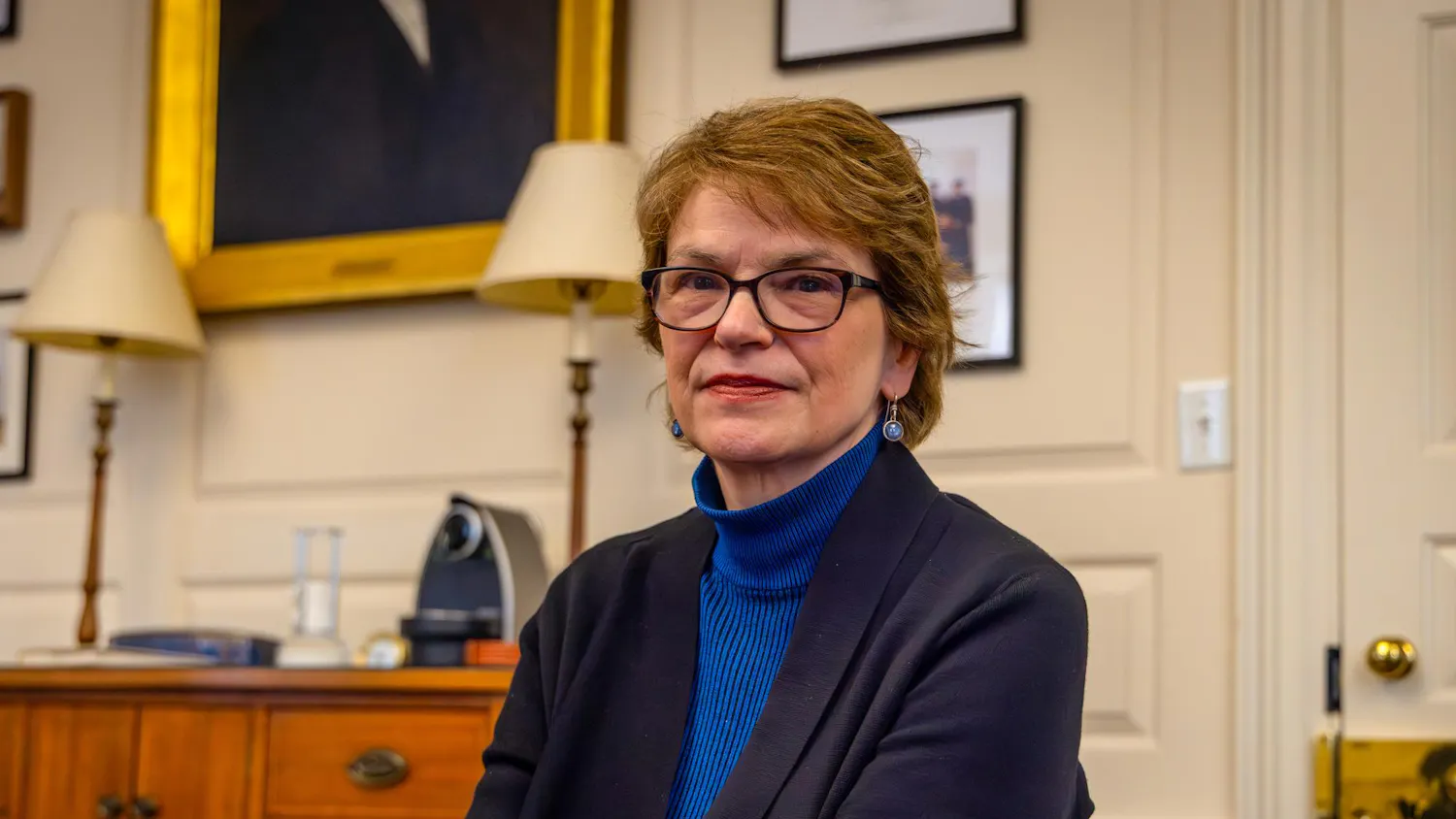
Inside the paneled drawing room of Rochambeau House — now home to both the Departments of Hispanic Studies and French and Francophone Studies — dozens of Brown and Providence community members gathered Thursday evening for the launch of “Picturing the Past,” a new lecture series by University Curator Nicole Wholean.
The series aims to “connect members of the Brown community with our Brown Portrait Collection and the rich institutional history it embodies,” Wholean explained. With the lectures, Wholean wants to build active, narrative-driven ways of experiencing art because “audiences prefer a more dynamic engagement — attending talks and tours — over simply reading static wall labels,” she wrote in an email to The Herald.
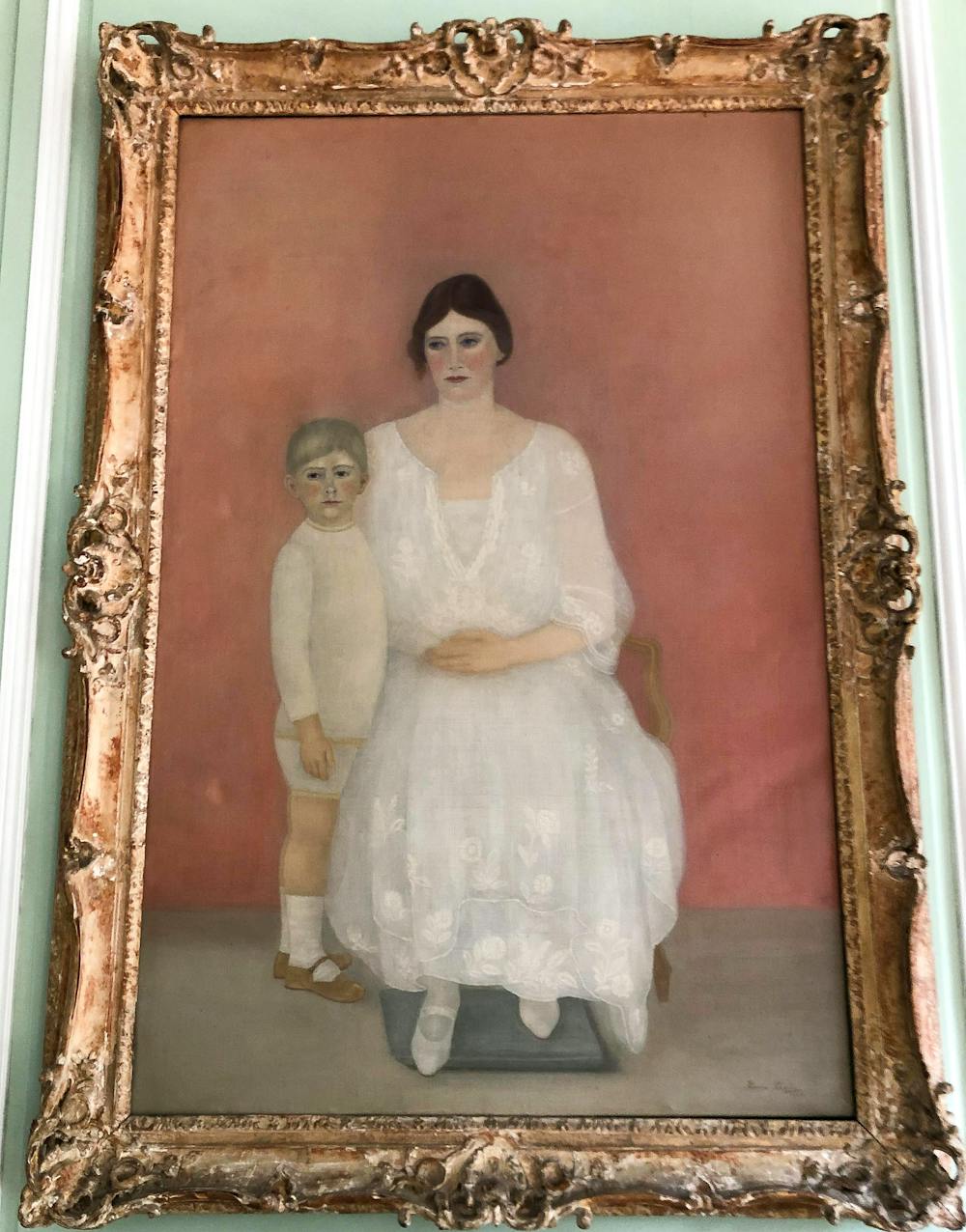
Thursday’s talk centered on a portrait that hangs in Rochambeau’s front drawing room: a piece entitled “Mother and Child,” painted in 1930 by artist Florence Koehler. In the painting, Mary Elizabeth Sharpe P’45 has an arm around her child, Henry Sharpe Jr. ’45, who is standing next to the chair she is sitting on.
Wholean used the painting as a means for telling Mary Elizabeth Sharpe’s story, rather than focusing solely on Koehler’s technique and style. Beyond being one of the namesakes of the Sharpe Refectory, Mary Elizabeth Sharpe shaped Brown’s campus in more ways than students may know, Wholean said.
Mary Elizabeth Sharpe was born Mary Elizabeth Evans in October of 1884. Born in Syracuse, New York, she was the oldest of four children. By the time she died in 1985, she cemented her status as a businesswoman and philanthropist.
But long before Mary Elizabeth Sharpe became a major benefactor to Brown, she was a teenage entrepreneur. After Mary Elizabeth Sharpe’s father passed away, she began making and selling candy to support her mother and siblings. Lacking staff, she used an honor-system storefront, leaving candy unattended in a cupboard and trusting customers to make their own change. The sign in her store read, “Open these doors. Take what you wish. Leave cost of goods taken. Make your change from my till.”
“This is a remarkably true story of a young girl with no business experience or capital,” Wholean added. At just 15, Mary Elizabeth Sharpe was the youngest businesswoman at the time in the United States.
Her business soon expanded into tearooms in Newport, New York City, Syracuse, Boston and Hamilton — the capital of Bermuda.
Tearooms, Wholean said, were “the first modern business enterprise by women, for women.” They were one of the few places at the time where women could dine alone without scrutiny, she explained.
But with World War I looming and ingredients like butter and sugar being rationed, Mary Elizabeth Sharpe broadened her horizons. She joined the U.S. Food Administration and wrote a cookbook entitled “War Time Recipes.” In 1918, her culinary adventures continued when she moved to Paris to run a Red Cross kitchen.
After the war, Mary Elizabeth Sharpe married Providence industrialist and eventual University Chancellor Henry Sharpe P’45, class of 1894. Eventually, she turned her focus from food toward art and design. Her involvement in the art world also led her to befriend Koehler, who painted her portrait.
But the portrait is just one facet of Mary Elizabeth Sharpe’s lasting legacy on campus and in Providence. While her husband sat on the Corporation, then-University President Henry Wriston approached Mary Elizabeth Sharpe in the 1940s requesting she spearhead the planting of trees around campus. Mary Elizabeth Sharpe proposed something far more ambitious: a unified landscape plan for the entire campus.
By that point, Mary Elizabeth Sharpe and her husband had brought Rochambeau House to life on 84 Prospect St., and she designed a tranquil garden that students still enjoy.
But when Wriston agreed to Mary Elizabeth Sharpe’s plan, she was lacking in funds, staff and training. Nonetheless, she began selecting magnolias, cherry trees and evergreens to ensure Brown would have “successive color throughout the seasons,” Wholean said. She donated her own plant cuttings, raised funds and designed outdoor spaces as “rooms” meant to encourage gathering and movement across campus, according to Wholean.
Mary Elizabeth Sharpe’s civic work extended beyond Brown. In Providence, she helped redesign India Point Park and funded a matching tree-planting initiative with the city, a model that national programs still replicate today. “She used creativity and generosity as tools for civic change,” Wholean said.
One attendee at Wholean’s talk, Kqantu Pareja Bent ’04, the senior regional director for international advancement at Brown, said the talk changed how she sees the campus spaces she encounters every day.
“I’ve always loved being in this building. It’s my favorite place on campus,” Bent said, referring to Rochambeau. “Hearing how entrepreneurial she was, and how she worked within the confines of her time, really inspired me.”
“The work she did creating park space and trees in Providence shows the power of just one person,” she added.
Fraser Gilbane, a Providence resident, said she decided to attend after hearing about the event through a local garden group. Gilbane said she was especially drawn to the Thursday event because she knew Peggy Sharpe, Mary Elizabeth Sharpe’s daughter-in-law, who passed away in 2024.
“I was struck by what a strong woman she was — resilient, enterprising and committed to what she believed in,” Gilbane said of Mary Elizabeth Sharpe. “It’s something we need to remember today.”

Talia LeVine is a section editor covering arts and culture. They study Political Science and Visual Art with a focus on photography. In their free time, they can be found drinking copious amounts of coffee.

Summer Shi is a senior staff writer and illustrator for the Brown Daily Herald. She is from Dublin, California and is currently studying design engineering and philosophy.