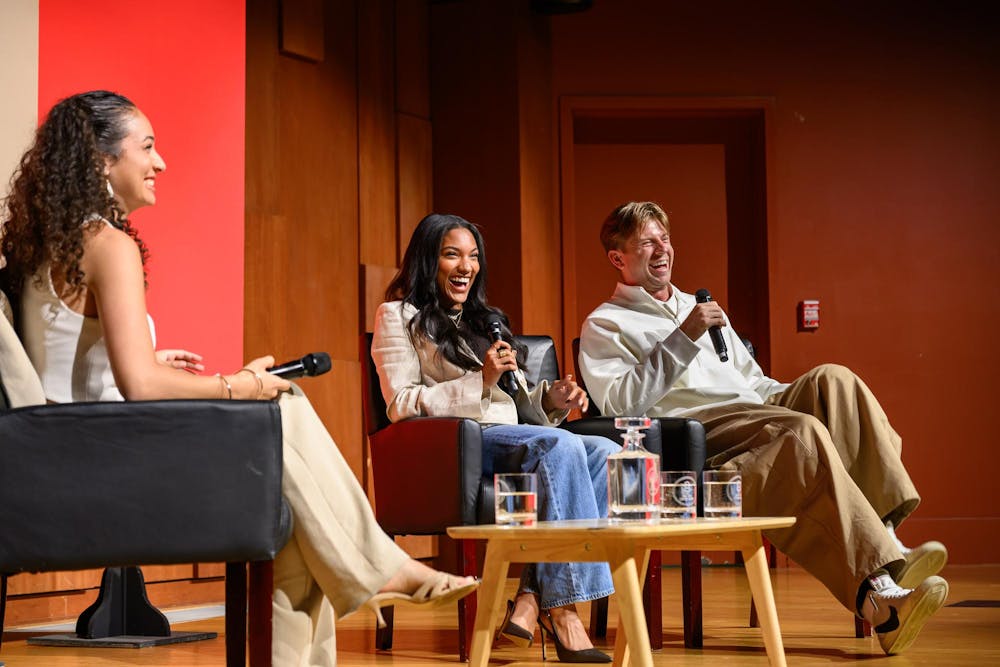
Attendees at the Brown Lecture Board’s semesterly talk rose to their feet as Tara Davis-Woodhall and Hunter Woodhall strolled, smiling, onto the stage of the Salomon Center’s De Ciccio Family Auditorium on Monday night.
Moderated by Brown Lecture Board President Samantha Chambers ’26, the hourlong conversation touched on the Woodhalls’ experiences with athletic success, navigating relationships and overcoming adversity.
Last year, the Woodhalls rose to the pinnacle of the track and field world, with Davis-Woodhall winning her first Olympic gold medal at the 2024 Paris Olympic Games, just weeks before Woodhall won his first gold medal at the 2024 Paralympic Games.
Outjumping two-time world champion Malaika Mihambo, Davis-Woodhall clinched the top podium position in the long jump with a 7.10-meter effort. Rounding the lap in only 46.36 seconds, Woodhall took home the gold in the 400-meter event for the T62 class — a World Para Athletics designation for athletes with double below-the-knee amputation who compete with prosthetics.
“Our prevailing mission isn’t just to bring really influential people to campus, but also to be able to respond to contemporary cultural moments and spark conversation across our student population,” Chambers, a former Herald university news editor, wrote in an email to The Herald. “And I think the Woodhalls are super emblematic of that goal.”
Chambers opened the conversation by revisiting one of the defining moments of the 2024 Olympics — when Davis-Woodhall, after securing the gold medal, sprinted off the field and leapt into the arms of her husband in celebration.
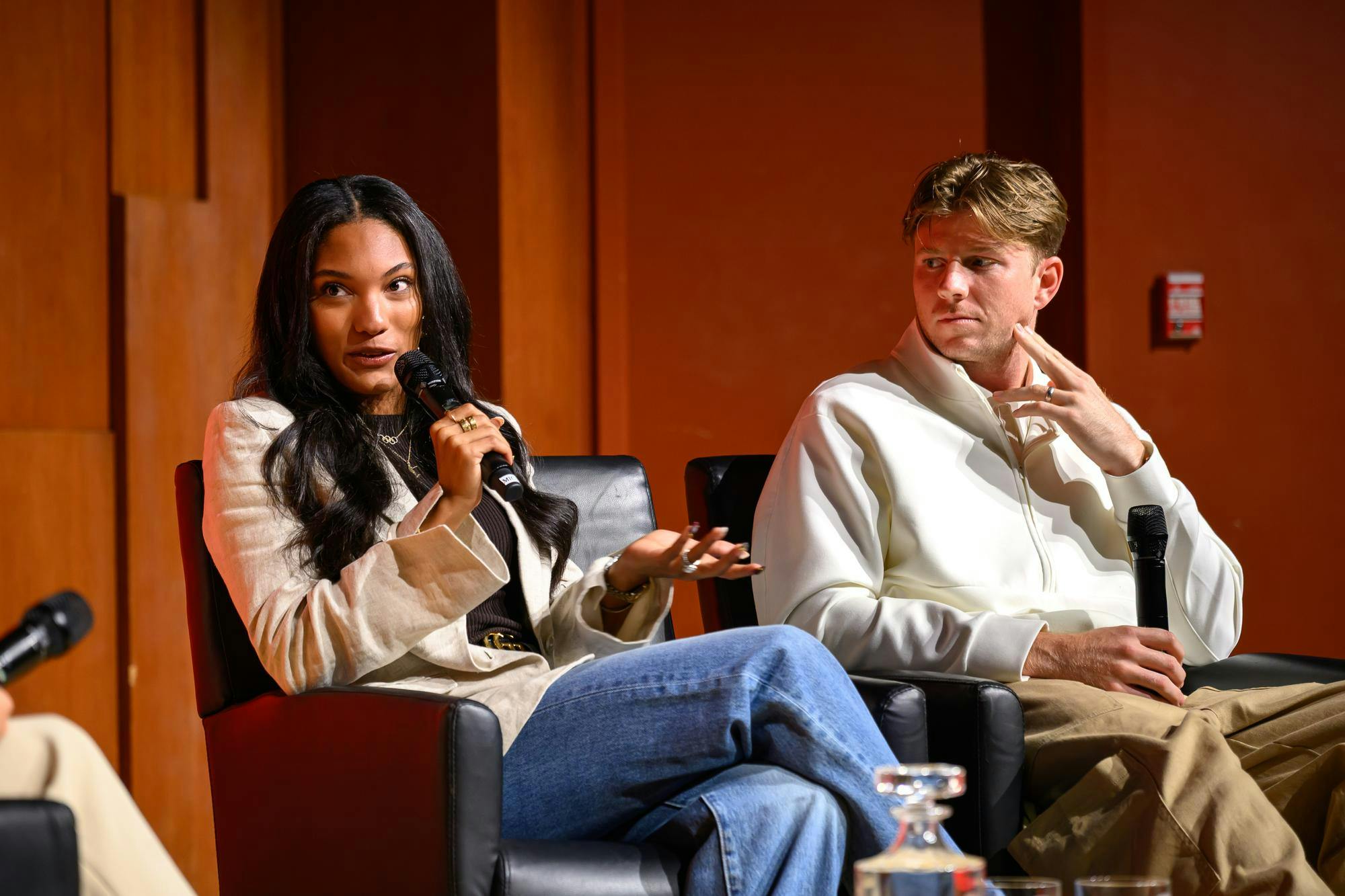
“I see women’s sports as big as men’s sports,” Tara Davis-Woodhall said at Monday's Brown Lecture Board event. “It’s just going to take a bit of time to get there, but I think it’s going to do it for sure.”
“It was a really personal, intimate moment,” Woodhall reflected. “What I didn’t know is that somebody across the stadium was filming, and so that whole moment, that whole experience, we both thought that we were the only ones to experience it.”
But the road to becoming Olympic and Paralympic champions was replete with adversity — experiences the duo believes have strengthened their resolve and influenced their lives.
Woodhall was born with fibular hemimilia, a condition in which the lower legs do not grow fibulas.
“My ankles were fused, I didn’t have a fibula bone and the initial reaction from doctors was that I’d never be able to walk because I had no function of my foot, ankle (or) calf,” Woodhall explained.
After a surgery in which both of Woodhall’s legs were amputated, and once Woodhall began using prosthetics, he said he was “just like any other kid.”
“I learned to walk — I’d walk, fall down, get up and keep going,” he said. “It’s everything I knew.”
Now, Woodhall wants to use his platform to open more conversations about what it means to live with a disability.
“My number one goal is to get people to be comfortable with having a conversation about disability, about sport,” he said.
Woodhall also revealed that, in partnership with Deloitte, McLaren and Disney, he is embarking on a project to build “the best possible prosthetic legs that have ever been made. And we’re going to try to break the able-bodied world record in the 400-meter.”
“I want to change the perception of what it means to have disability, what it means to be different and show that the thing that makes you different might be the one thing that allows you to change the world,” Woodhall said.
As one of the defining athletes of her generation, Davis-Woodhall touched on the current climate surrounding women’s sports. “There’s so many areas that need to be improved, but I can say that it’s working,” Davis-Woodhall began.
“I see women’s sports as big as men’s sports,” she added. “It’s just going to take a bit of time to get there, but I think it’s going to do it for sure.”
Addressing the student-athletes in the auditorium, Davis-Woodhall shared some of the advice she gives her athletes as assistant track and field coach at Kansas State University.
“Just to enjoy the moment,” she said. “You’re not going to make the right decision every single time.”
Echoing her point, Woodhall explained that in the couple’s house, they have a saying: “You either win or you learn.”
“The hardest thing you’re ever going to go through in life, the hardest thing that you ever have to deal with in life is going to be the best lesson you’ve ever learned,” he said. “It’s going to be the thing that allows you to go farther and do the next thing. You really win or you learn, and those opportunities where you don’t win, you learn a very important lesson.”
“Look at failure with a positive light,” he added.
Chambers then directed the conversation to the Woodhalls shared YouTube channel, which has almost one million subscribers.
“We share a lot online, but we also keep a lot in-house,” Davis-Woodhall said. “We are athletes, but at the end of the day, we are humans, and we’re just like you guys — we’re just like anyone out there.”
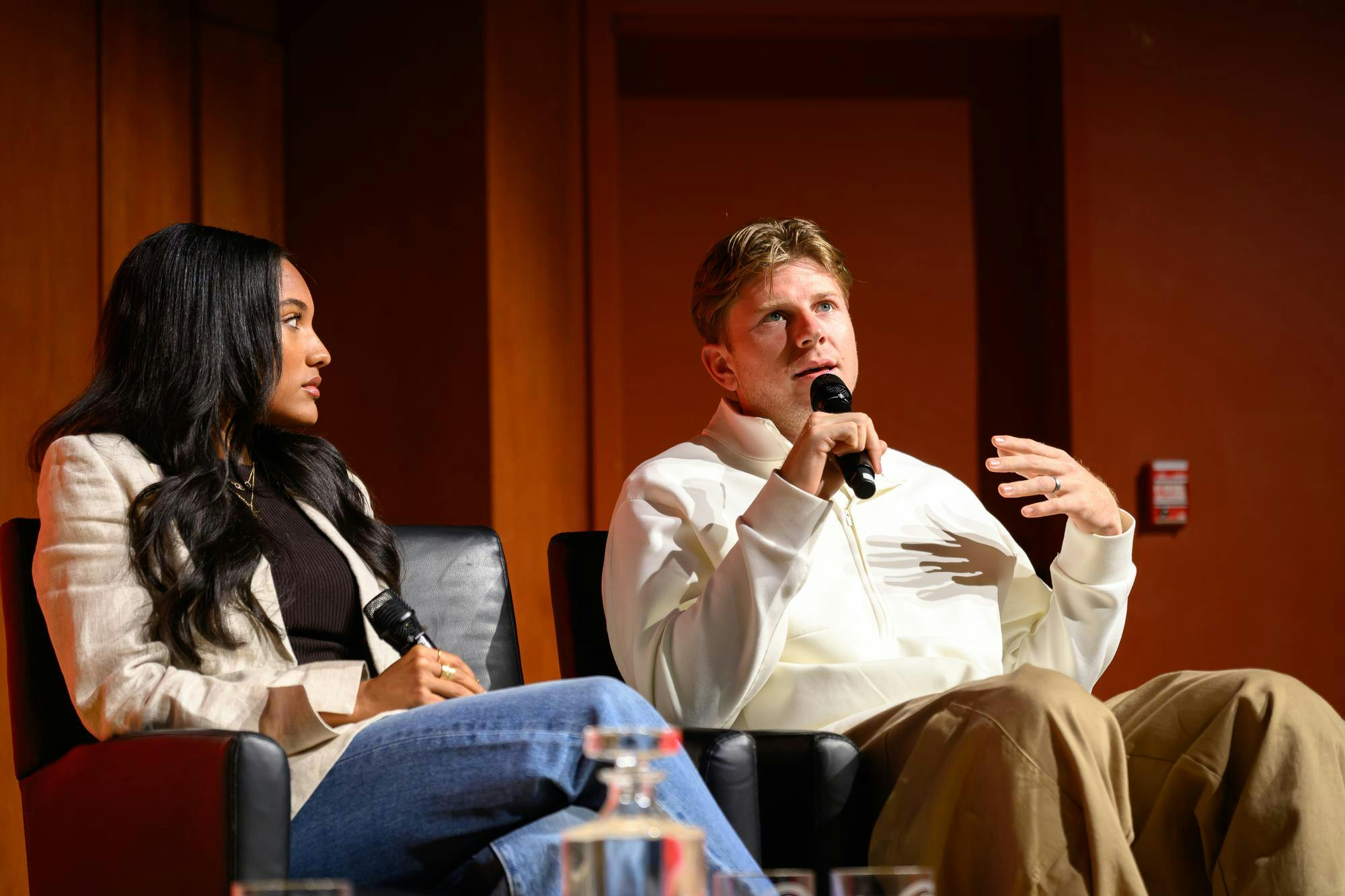
“Look at failure with a positive light. It’s going to happen," Hunter Woodhall said. "You’re going to fail, you’re going to mess up, you’re going to make mistakes. See how you can learn from them and get better, and that’s what’s going to lead you to whatever it is you want to do in life.”
Other than relatability, the Woodhalls make a point of being vulnerable. Woodhall explained that they intentionally show online “how messed up and flawed we are as humans, how imperfect we are and how we have bad days.”
“It hopefully shows that the things that make us unique, the things that make us different and perfect are the things that have allowed us to change the world, inspire people and chase our own dreams,” he added. “At some point you’ll learn it’s not a burden, it’s a blessing, and it’s going to allow you to make the world a better place.”
Speaking about their relationship, Davis-Woodhall said “we’re best friends.”
The 2024 Olympics was “one of the most humbling moments of my life,” Woodhall confessed in turn. “Tara won the Olympic gold medal, the biggest dream of her entire life,” but rather than bask in the attention, she didn’t talk to the media until after Woodhall competed in the Paralympic Games.
“She’s the most incredible, humble person in the world,” he concluded. “If you’re a fan of her — for whatever reason that you’re a fan of her — you are a fan of the exact person you think you are.”
After the first half hour, Chambers opened the session to questions from audience members. In response to a question about how they reset after the Olympics, Davis-Woodhall said that “we don’t think about a track for a really long time.”
“We give ourselves a big break — longer than six weeks — because we want to miss the track,” she added. “We want to be able to have a rebound love after the Olympics.”
Attendee Nina Kruzewska ’27, a member of the women’s track and field team, said the event encouraged her “to pursue her dreams and go for it.”
Aaron Caveney ’27, a distance runner on the track team, said he thought it was “inspiring to hear such successful people talk about how they were able to get it done, even when life throws curveballs.”

Lydell Dyer is a sports editor for The Herald. A junior hailing from Bonn, Germany, Lydell is studying nonfiction English and political science, and if he's not off "making words sound pretty," you can find him lifting heavy circles at the Nelson.