
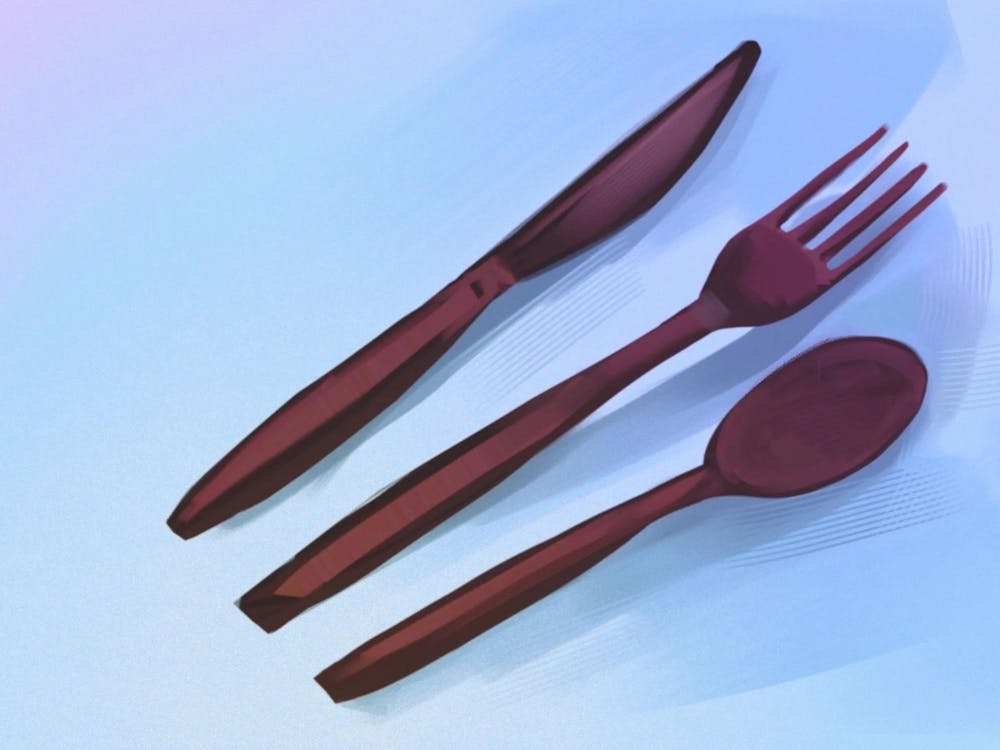
As soon as meal times approach, hoards of students can be found across campus munching on Ivy Room salmon bowls, grabbing a Blue Room salad or slurping pho from Andrews Commons. All of these dining options have one thing in common: They are served with a side of plastic silverware. Every day, Brown students on meal plans use countless plastic forks, knives and spoons to eat their food — cutlery that often ends up in the landfill, polluting our air and water and contributing to global warming. The next step Brown should take in the effort to safeguard the health of both the planet and its students is to end the use of disposable plastic silverware on campus.
The University has been vocal and proactive in its efforts to implement and maintain sustainable practices on campus. In spring 2024, Brown Dining Services replaced all plastic takeout containers at the Sharpe Refectory and Verney-Wolley Dining Hall with reusable containers through a partnership with ReusePass. In an effort to reduce its nitrogen emissions, the University decreased the use of red meat and introduced half-beef, half-mushroom burgers at Josiah’s. And, each dining hall on campus composts in their respective kitchens, while Ratty diners are also able to compost their food on the way out. These environmentally friendly dining initiatives are complemented by a number of other sustainable efforts on and off campus, such as the ongoing construction of a massive solar farm in North Kingstown that will produce the vast majority of Brown’s energy. Eliminating plastic silverware feels like a clear next step for the University.
More than 100 million plastic silverware are used daily in the U.S., and the environmental harm caused by our ubiquitous usage does not go unnoticed. Despite their convenience, plastic cutlery can take 200 years to decompose. This waste comes with a financial price: Every year, New York spends $42 million dealing with the waste caused by single-use cutlery. But when plastic silverware is not properly disposed of in the landfill, it can end up in waterways, making it one of the largest threats to marine ingestion.
However, the consequences do not end there. Plastic silverware significantly contributes to the five grams of plastic the average person consumes every week. Microplastics in the human body can decrease fertility and increase risk of colon and lung cancer. In addition, when eating hot foods, plastic releases harmful chemicals like BPA causing microplastics to be dispersed even more readily. The study of microplastics, both its effects on humans and the environment, is a relatively new and exponentially growing field, and one that Brown itself is involved in. We should not let ourselves remain the field’s guinea pigs. Simply put, the spoon’s worth of microplastic that is believed to exist in the average human brain should be reason enough to turn away from the plastic spoons in our dining hall.
For a university who claims commitment to student and environmental health, an actionable, and very feasible next step would be the elimination of plastic silverware in our dining halls. Metal silverware, as is used in the Ratty or VDub, would be the least harmful alternative, as it is not only reusable but also does not contain microplastics. However, if that choice is not feasible, more sustainable alternatives exist. Even though it is slightly more expensive, compostable utensils made out of corn are a great plastic free, plant-based alternative. However, it is not the only option; bamboo or wood cutlery are also viable substitutes. While each alternative does have their own set of challenges, such as cost or durability, they come with a myriad of benefits. If, for example, Andrews started using one of these alternatives options, every food product handed to each student — the bowls, silverware and food itself — would be compostable except for the optional lids provided for the bowls, thus making it feasible for Andrews to begin front-of-house composting for diners. This small switch can lead to a cascade of attainable and sustainable action.
There is no perfect solution to the environmental upheaval or health effects that come from living in a plastic-dominated society. However, the switch away from plastic utensils is a step towards a more conscious and sustainable university.
Talia Berkwits ’29 can be reached at talia_berkwits@brown.edu. Please send responses to this op-ed to letters@browndailyherald.com and other opinions to opinions@browndailyherald.com.
Talia Berkwits is a staff columnist. She is from Chicago, IL and undecided on her concentration. She loves cooking (but not cleaning up) and one of her goals is to visit all 50 states.


