When the Ruth J. Simmons Quadrangle reopened in mid-October after a five-month closure, passersby likely noticed the newly dedicated Stephen Sondheim Amphitheater.
But behind the fences that surrounded the site during its renovation, most of the project did not involve building the amphitheater itself. Roughly two-thirds of the construction project took place underground, according to Paul Dietel, the assistant vice president for planning, design and construction.
Beneath the renovated quad, the University installed water storage tanks “that will accept the high volume” of rainwater produced during high-intensity storms. The University also increased the sizes of the quad’s underground pipes, which “were quite literally at capacity,” Dietel said.
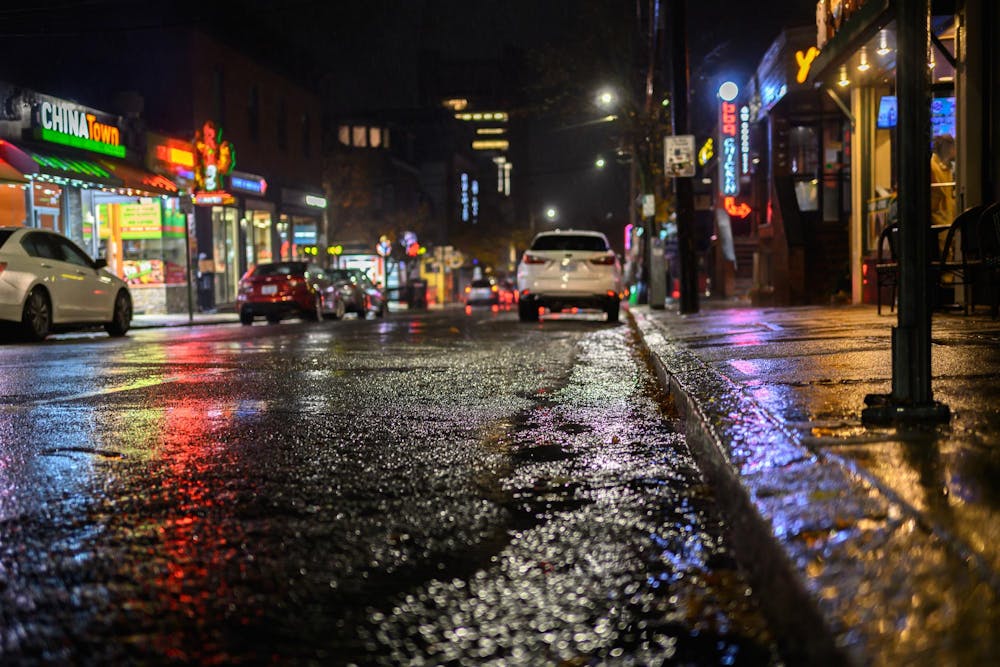
The Simmons Quad renovation is just one part of the University’s growing effort to adapt aging campus infrastructure to increasingly severe storms. In recent years, rainwater from these storms has flooded campus buildings, from first-year dorms to dining halls.
The quad’s new stormwater system, like other recent projects on campus, is a recognition of recent “changing conditions with heavier rainwater events,” Dietel said.
“There’s not a single campus across the country that is immune to climate-related impacts and threats to its infrastructure,” said Kim Cobb, director of the Institute at Brown for Environment and Society.
But at Brown, these storms pose a challenge to a campus that is connected to a strained city stormwater system, Dietel explained. Many of the centuries-old buildings around campus were not built to modern waterproofing standards.
“All our infrastructure is tied directly into the city of Providence,” he explained. “The city system, way back when it was built … really wasn’t designed to accommodate those micro bursts.”
In the case of the centuries-old Simmons Quad, “the drainage network from the quad and the surrounding buildings was overwhelming the city system,” Dietel said. He added that the University hopes that the new storage tanks will allow stormwater to slowly dissipate into the ground or move into city pipes when the city’s system is no longer at capacity.
Since Brown’s campus sits atop a hill, rainwater not retained onsite can either accumulate on College Hill or flow into the City’s stormwater or sewer systems, Dietel said.
When the City’s system can’t keep up with heavy rainfall, the University’s campus becomes prone to flooding.
In urban areas like College Hill, the risk of flooding is elevated “because large portions of land are covered by impervious surfaces,” said Teaching Professor of Engineering Indrek Külaots PhD’01, who teaches courses on water supply and treatment systems as well as environmental engineering.
As a result, it doesn’t take a large storm to cause flooding in many urban areas, Külaots explained.
City Press Secretary Anthony Vega told The Herald that Providence does not collect data on Brown’s “overall stormwater impacts.” But he noted that “all areas of development with impervious surfaces place strain on the city’s stormwater system during significant or intense rain events.”
Simmons Quad is not the only site of Brown’s effort to collect and store stormwater on campus.
Local and state regulations require large property owners like Brown to take steps to filter and contain stormwater. Brown’s 2023 Stormwater Master Plan, for instance, established a three-way stormwater credit system between the University, the City of Providence and the Narragansett Bay Commission. The system incentivizes Brown to reduce its stormwater footprint through measures like rain gardens and enhanced filtration.
This past summer, the University also excavated the side of Rhode Island Hall and installed exterior water pumps that would divert water to a city drain on George Street — a project that Dietel called one of the more “extreme” examples. In 2020, Brown completed a similar project on the exterior of the Sciences Library, Dietel added.
Cobb welcomed these new efforts to fortify campus buildings and mitigate rainwater accumulation, explaining that she sees steps like these as a necessary part of climate resilience.
The impacts of climate change on College Hill have “been a long time coming,” Cobb said. “You often do need to wait to see those impacts on the ground before you make the deep investments.”

Ethan Schenker is a university news editor covering staff and student labor. He is from Bethesda, MD, and plans to study International and Public Affairs and Economics. In his free time, he enjoys playing piano and clicking on New York Times notifications.