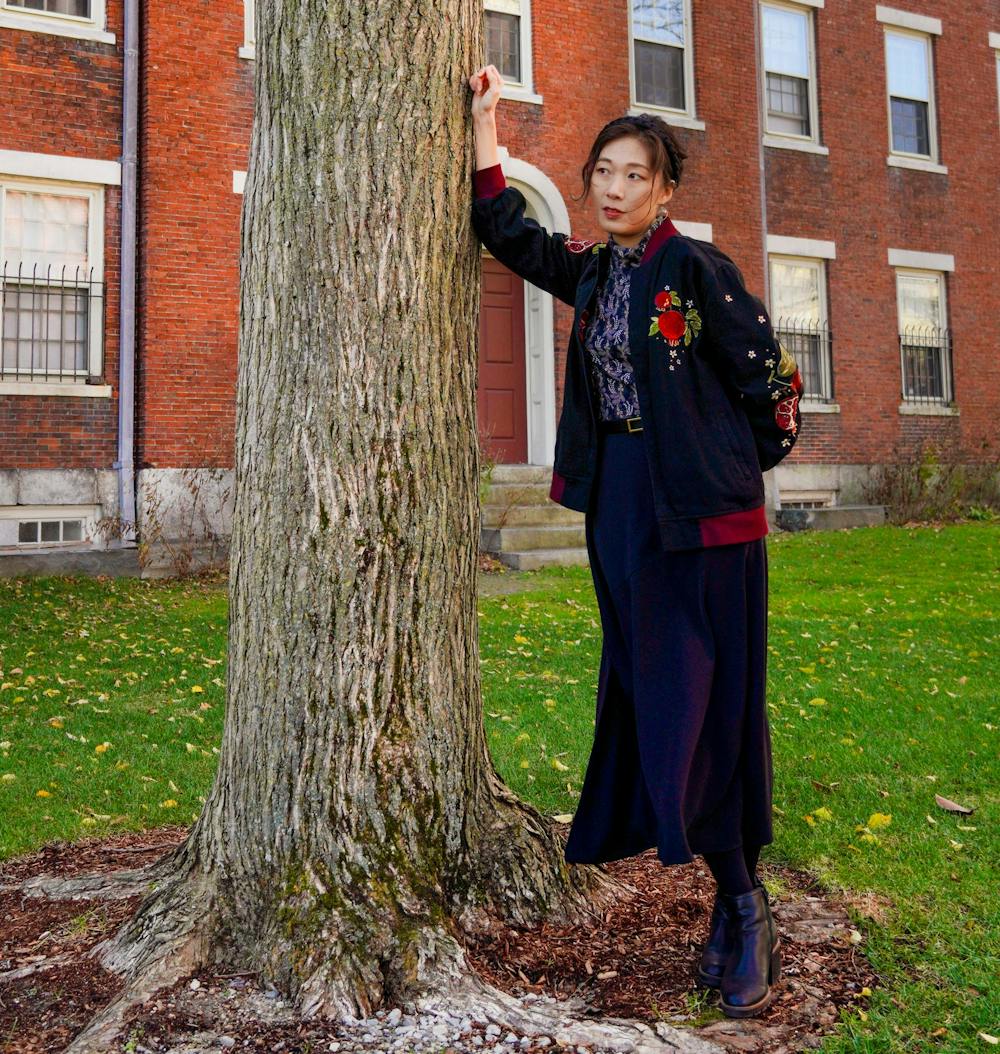
When Mariah Min, an assistant professor of English, gets dressed in the morning, the first thing she considers is the weather. Since she began teaching at Brown, she has replaced much of her wardrobe with waterproof counterparts.
Apart from practical considerations, Min asks herself what kind of person she needs to be to approach the day ahead of her, “envisioning and then manifesting a version of myself in the world.”
Min’s favorite outfit to wear is a bomber jacket with pomegranates embroidered on it — an item that makes her feel “artsy and quirky.” She recalled how “a woman on the Amtrak offered to buy” the jacket — which was created by an independent artist who runs the brand Morningwitch — off her back.
Min is currently teaching ENGL 1311P: “Medieval Drama,” which culminates in the hands-on staging of a medieval play. Min said that the class requires a lot of movement, and the jacket gives her the freedom to “move my limbs the way they need to be moved.”
For professors like Min, fashion is a way to complement their teaching and express their identity. The Herald spoke to a few of these fashion-forward professors about how they select their outfits.
Richard Kimberly Heck is a professor of philosophy and linguistics, as well as the director of graduate studies in the Department of Philosophy.

Professor of Philosophy and Linguistics Richard Kimberly Heck is also the director of graduate studies in the Department of Philosophy.
Heck, who is genderqueer, considers “where (they’re) feeling in terms of gender expression on a particular day.”
“I occasionally wear a dress or skirt to teach,” they said in an interview with The Herald. “I do dress in conventionally masculine ways, but a lot of the time I dress in more feminine ways.”
Heck’s favorite item of clothing from their wardrobe is a purple dress with geometric patterns.
“It’s a nice mix of really colorful and playful, but at the same time, it’s professional enough to wear to work,” they said. “The mix of colors, the pinks and purples, are really cool.”
Before coming out, Heck said they were “infamous” for wearing the same thing every day.
“I was pretty much the ‘man in black,’” Heck said, referring to Johnny Cash’s head-to-toe black outfit ensembles. But as Heck began to express their identity more fully through their fashion, they noticed their relationships with students “changed.”
“Students would come and talk to me about things that they never would have talked to me about before,” they said, noting that this has improved their advising relationships with students.
Mari Mota Lopes GS, who is a graduate student teaching courses in the Department of Portuguese and Brazilian Studies, also found their style has brought them closer to their students.
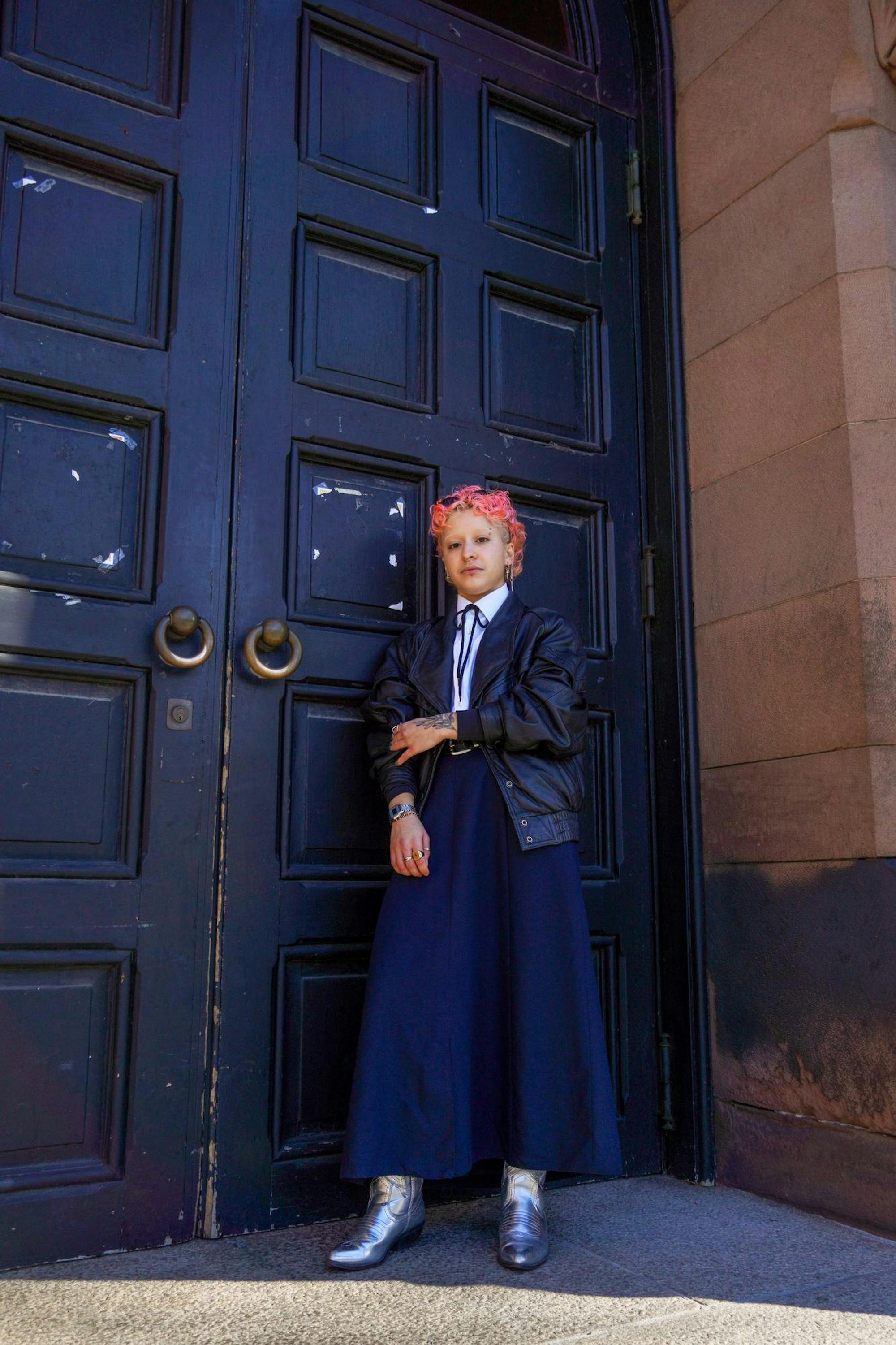
Mari Mota Lopes GS is a graduate student teaching courses in the Department of Portuguese and Brazilian Studies.
“The way I dress up really helped me … get closer to my students and to break the idea that academia should be bland,” they said in an interview with The Herald.
Lopes likes to wear different combinations of outfits because “every day feels different.” They said they set aside time each day to “examine how (they) want to be seen.”
Recently, Lopes thrifted a leather jacket, a product they usually don’t buy for “ethical reasons.” But this time, they felt that they “could express themselves in a different way through this jacket” and through the material.
“I’ve been feeling like embracing playfulness with gender and sexuality as a (form of) expression and fashion,” they said.
But Lopes also noticed that the way they dressed was “associated with immaturity, (naivete) and being dreamy,” which “tends to make people less confident about my professionalism.”
Ultimately, Lopes said that “being intentional” with one’s style is critical.
Richard Snyder, a professor of political science, said that his academic area of interest mirrors how he dresses.
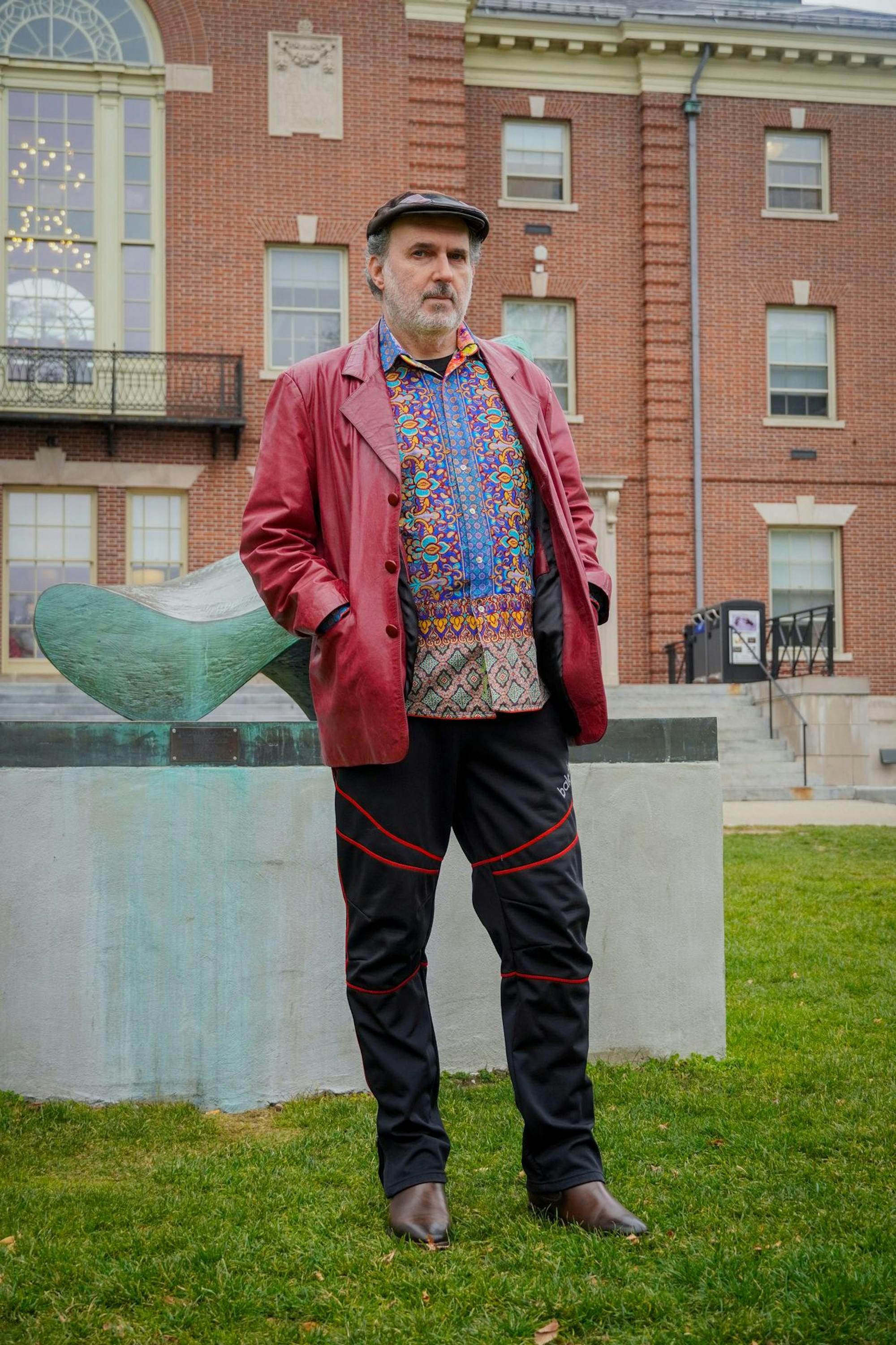
Richard Snyder, a professor of political science, said that his academic area of interest mirrors how he dresses.
Snyder, who has worked at Brown for 21 years, noted comfort as a factor for how he chooses his outfits. But what distinctly influences his fashion style is more closely related to the region of his academic expertise: Latin America.
While he does not have a particular favorite outfit, Snyder mentioned that he is fond of leather jackets and “some interesting boots.” Snyder brings the boots in when he teaches import substitution industrialization in POLS 1240: “Politics, Markets and States in Developing Countries.”
The boots are from Salta, a small province in Argentina, and were likely made from some machinery that had been imported from the United States, Snyder said. In this way, he said that his fashion was also “partly pedagogical.”
Snyder said that being a college professor “gives you the freedom of the artist.”
“I don’t have to wear a uniform. In fact, I never wanted to,” he said. “It is great that one of the big perks — and there are many perks of being a professor in a place like this — is the freedom to wear what I want.”
“As long as you’re not being harmful or offensive, you have the option to make it interesting and different if you want to,” Snyder added. “And I think that’s good for the students, good for me.”
Rahul Sameer is a staff writer from Singapore. He plans to concentrate in Applied Mathematics. In his free time, he plays tennis and Mahjong.