
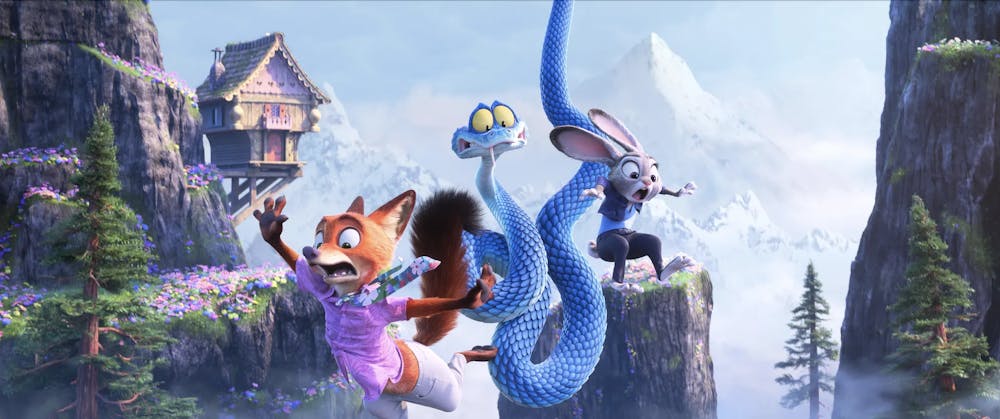
Almost 10 years have passed since bunny cop Judy Hopps (Ginnifer Goodwin) and con artist fox Nick Wilde (Jason Bateman) first won the hearts of children worldwide in Disney’s smash-hit animated movie “Zootopia.” The first film — which earned over $1 billion globally — won Best Animated Feature Film at the 89th Academy Awards. Last week, theaters revisited the fantastical city of Zootopia to watch the duo solve yet another case in “Zootopia 2.”
Released on Nov. 26, “Zootopia 2” grossed $156 million in North America and an additional $400 million worldwide in its first five days, the fourth-highest global opening of all time and the highest-ever opening for an animated film.
Set just days after the first movie takes place, “Zootopia 2” presents the pair with a new investigative challenge. Despite their previous success, Judy and Nick — now both police officers — face doubts that they can synchronize their clashing identities and work as a team. Determined to prove themselves, they defy expectations in pursuit of justice.
Zootopia is only home to mammals, so when evidence points to the presence of a rogue snake in town, the duo is determined to get to the bottom of the problem. But when they finally encounter the snake, they realize — in a turn characteristic of children’s movies — that reptiles are not as bad as they have been made out to be. Judy and Nick find themselves on the run from the police as they embark on an ambitious quest to uncover the truth about reptiles.
“Zootopia 2” introduces viewers to a richer depiction of Zootopia’s history, culture and politics, delighting children and adults alike with its thoughtful world-building. The movie delves into the inner workings of the intricate city system and animal class divisions. But despite their superficial allure, these issues are under-developed and, at times, raise more questions than they answer.
For instance, the timeline of Zootopia’s founding is hazy, neglecting to clarify when reptiles were pushed out of the city. Additionally, the movie references a time before the founding of habitat-based neighborhoods, raising a plethora of questions about how animals survived outside their natural environments.
Moreover, the sequel’s portrayal of reptiles is often contradictory. Initially, reptiles are presented as almost mythical creatures that have not been seen in Zootopia for generations. But later in the movie, Judy and Nick stumble upon a secret community of hundreds of reptiles, who receive the duo with little fanfare. The reptiles’ understated reaction to outsiders in their midst, as well as the sheer number of them, undercuts the idea that hundreds of reptiles have been living in seclusion for generations.
But despite its faults, “Zootopia 2” carries on the first movie’s legacy of hilarious puns and pop culture references. Whether it’s a long water pipe — dubbed the “Tube” — taking animals where they need to go, the infamous “Burning Mammal” festival or the water-walking, plumed basilisk lizard named Jesús, the film’s writers and directors keep the audience captivated. (At one point, the characters even leave the dazzling Zootopia to visit “Gnu Jersey,” the state adjacent to Zootopia.) With witty writing, stunning graphics and an engaging storyline, “Zootopia 2” is sure to become a classic in its own right.
Michaela Hanson is a senior staff writer covering community and culture.


