
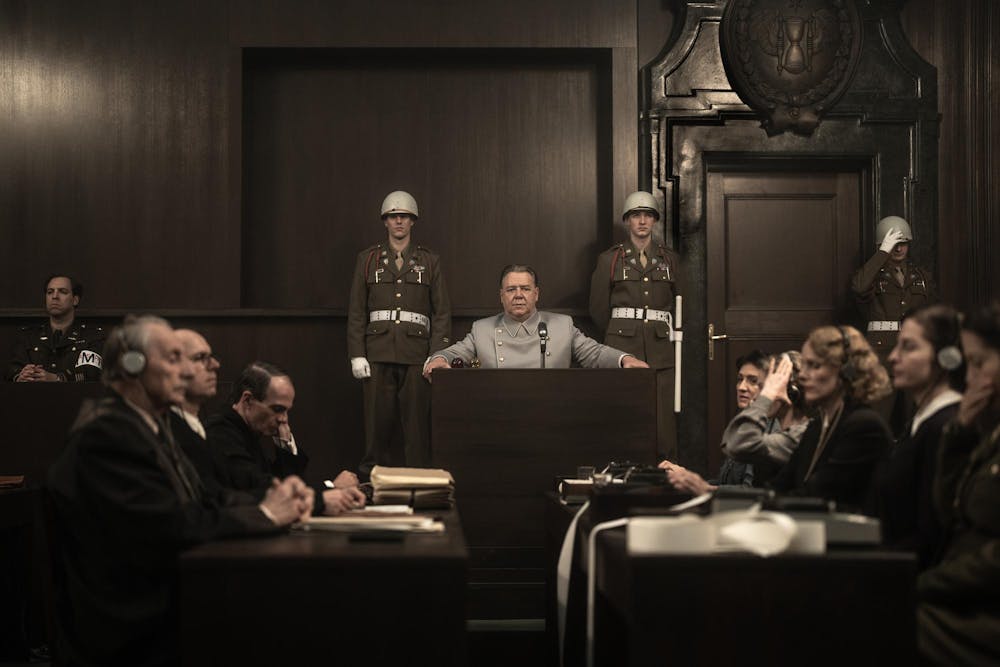
After Hitler’s second in command is imprisoned in May 1945, an American psychiatrist arrives in Europe tasked with ensuring that the prisoner, along with other Nazi leaders, are mentally fit to stand trial — and that none of them die by suicide before that time. But over the course of his time in Nuremberg, he begins to see himself in the genocidal masterminds he has been ordered to treat.
The film “Nuremberg,” directed by James Vanderbilt, captures this story in a cinematic adaptation of journalist Jack El-Hai’s 2013 biography “The Nazi and the Psychiatrist: Hermann Göring, Dr. Douglas M. Kelley and a Fatal Meeting of Minds at the End of WWII.”
After World War II, top surviving Nazi leaders were tried for war crimes in Nuremberg, Germany. Testimony and documents presented at the Nuremberg Trials revealed considerable information and visual evidence of the horrors of the Holocaust publicly. At just under 150 minutes, Vanderbilt’s film follows American psychiatrist Douglas Kelley (Rami Malek) as he assesses the Nazi Party leaders held in Nuremberg Prison for committing these atrocities.
Throughout the film, Kelley attempts to get close with the prisoners — all of whom have committed countless crimes as Nazi leaders. The film zeroes in on the complex relationship between Kelley and Hermann Göring (Russell Crowe), a Nazi official widely viewed as second-in-power only to Adolf Hitler himself. It is a true history whose monumental and delicate nature requires the utmost care and intention, and Vanderbilt’s adaptation hits the mark.
In particular, Crowe’s performance of Göring is stellar. His stunning evocation of his character’s relationship with Kelley makes this role stand out in Crowe’s storied career. What starts as Kelley’s attempt to define evil morphs into a genuine, haunting connection between him and Göring over the course of the film. Eventually, Kelley sees himself in the Nazi and considers him a genuine friend.
Associate Supreme Court Justice Robert H. Jackson’s (Michael Shannon) efforts to establish an international tribunal complement the central story. But while Shannon’s performance is also exceptional, Jackson’s portions of the story can’t hold a candle to Vanderbilt’s exploration of Kelley and Göring’s relationship.
The film also follows interpreter Howard Triest (Leo Woodall), a German-born Jewish American whose parents disappeared at Auschwitz. Triest spends countless hours working as Kelley’s interpreter, all while keeping his Jewish identity hidden. The revelation of Triest’s religion is one of the most haunting yet moving scenes of the movie.
In a desperate plea to Kelley, Triest tells the doctor that he wants to reveal that he’s Jewish to the imprisoned Nazis. “I want to tell Streicher,” Triester says, referring to a leading propagandist for the Nazi Party Julius Streicher. “I want to tell him right before they put that rope around his neck, I’m going to tell that piece of shit that he was confiding in a Jew.”
In the film, it is this plea that compels Kelley to return to the Nuremberg Prison and give Jackson the information necessary to hold Göring accountable.
While the movie doesn’t depict Kelley’s life following the trials, in real life, the psychiatrist killed himself the same way Göring did — by swallowing cyanide.
Malek portrays Kelley’s desire to do good in parallel with his descent into insanity with great depth. His performance, as well as Crowe’s, will stick with viewers long after the conclusion of the film. By the end of the film, the viewer is transported inside Kelley’s mind and leaves feeling almost guilty that they, like Kelley, pitied Göring in spite of his atrocities.

Talia LeVine is a section editor covering arts and culture. They study Political Science and Visual Art with a focus on photography. In their free time, they can be found drinking copious amounts of coffee.


