
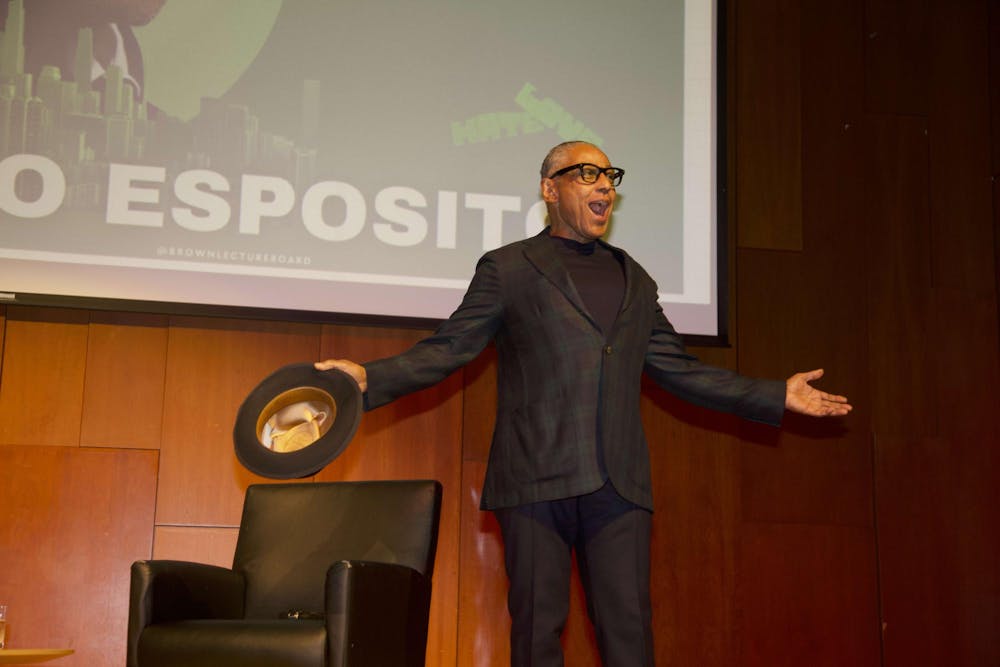
On Tuesday, actor Giancarlo Esposito arrived at the Salomon Center’s De Ciccio Family Auditorium for the Brown Lecture Board’s annual spring lecture. In a conversation with moderator Robayet Hossain ’26, Esposito outlined his five-decade acting journey, as well as how he approaches his roles as a villain.
Esposito is best known for his role as Gus Fring in director Vince Gilligan’s 2011 show “Breaking Bad.” Esposito held his then-largest role in his modern film career.
“‘Breaking Bad’ changed the game for me,” Esposito said at the lecture.
Esposito said he learned how to use silence as an intimidation tactic in his role as the villain. “I realize (as) human beings, we’re not accustomed to silence, to being shut down,” Esposito said. “It makes people nervous.”
Currently, Esposito holds a role in the TV series “The Boys,” acting as Stan Edgar, the series’ main antagonist, among other projects. Throughout Esposito’s acting career, he had various hit performances, such as the movie “Do the Right Thing” and the TV series “The Mandalorian.”
Prior to his role in “Breaking Bad,” Esposito largely played supporting roles. But following the show, he was asked to play characters who were in a “position of power.” In “Better Call Saul” — Gilligan’s 2015 prequel to “Breaking Bad” — Esposito also assumed a large role.
Esposito’s career first began in 1968 when he made his Broadway debut at only eight years old. “I fell in love with it,” he said.
In the Broadway musical “Maggie Flynn,” Esposito started by “playing street kids who carried guns and knives.” Morton DaCosta’s 1968 Broadway musical follows an Irish woman who runs an orphanage for children who were previously enslaved. Esposito played the role of one of the orphans, Andrew.
After doing that for a period of time, Esposito found that his acting could affect how his audiences “would then look at other young Black kids.”
For the rest of his acting career, Esposito strived to “break out of being looked at in a certain light.”
He added that there are “things that I build in the characters I play because I want them to be human. I don’t want them to be stereotyped or harder copies.”
Growing up, Esposito found that he was his own “worst enemy,” adding that he didn’t know how to address challenging circumstances with compassion.
But he said he learned how to “control the chaos” after making space to find his equanimity. “I take my own temperature.”
Steven Ma ’29, who was in the audience, said Esposito has a “stillness” that contributes to his “iconic” roles in his productions. As a result, he said he was excited to see Esposito live.
Casey Kittredge ’29 also said that this unique style made Esposito a “great” actor. “He’s playing these anti-hero characters who are very multi-faceted, very calm and collected,” Kittredge said. “That kind of goes for all of his work, and that makes all of his performances so captivating.”
But Amelia Allen ’27 noted Esposito’s animated character during the lecture contrasted with his generally “reserved” role in his productions. “It was just really great to see how much enthusiasm he had for what he did,” she added.
“To maintain courage to be able to speak out is really extremely important,” Esposito said.
“Do we have cause to be afraid for our world right now? Yes we do,” he added. “But fearing for that is also partially a weakness.”
It is “fear that stops you from being you, but that also stops you from being human,” Esposito said.
Esposito encouraged the audience to “play to your strengths, do what you’re good at, so that you fall in love (with) what you do and you never work a day in your life.”
“Dream big,” Esposito said. “Don’t wait to be great, because you’re great already, just as you are right here, right now, in this moment.”
Marat Basaria is a senior staff writer covering activism.


