
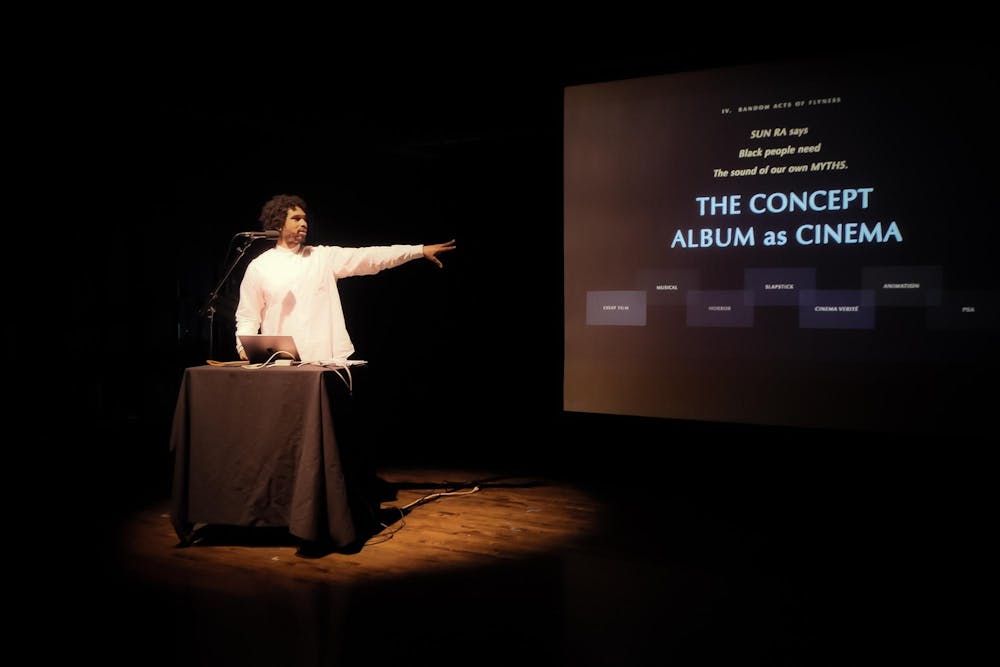
In a Friday talk, filmmaker Terence Nance brought the McCormack Family Theater to life with a discussion of his experimental work and film’s capacity to transcend dimension.
Hosted by the Department of Literary Arts through their “Conversations with Screenwriters” series, the event focused on “the power of cinema as a myth-making machine.” Nance, who titled the talk “Myth Making,” said people typically use myths to “signify fiction.” He hopes to challenge this by using myths as symbols for consciousness.
Filmmakers have a “profound capacity to deploy myths on people’s subconscious and shift the whole trajectory of the behavior of humans,” Nance said.
In front of an audience of about 30 community members, Nance played short clips from his portfolio of work, with snippets ranging from his first feature film, “An Oversimplification of Her Beauty,” to the most recent season of his HBO TV show “Random Acts of Flyness.”
Nance grew up surrounded by the arts. “I was a cartoon kid. The thing I did earliest as a person to express myself was draw,” he said. As the son of a news photographer and actress, Nance always felt like “the tools of the trade were around all the time.”
From a young age, Nance was drawn to cinema that was “transcendent” and visualized “the unseen,” such as films by Moroccan-born filmmaker Med Hondo. He said he was “really attracted to meta-films,” or “films that announce that they are films,” and incorporated this structure into his first film.
He works with what he calls “loopholes,” which he described as “time manipulations to make cinema behave more like a dream.” Nance explained that film can transcend the dimensions that define other forms of media. “It’s kind of a 2D medium that then jumps over the third dimension into the fourth,” he said.
This explanation resonated with audience members. Ibby Mian ’29 said Nance’s explanation of the dimensions demonstrated that “there’s just so many levels to being a screenwriter.”
In his short film “Swimming in Your Skin,” Nance focused on trusting his instincts. “I made a rule for myself that I would make whatever was channeled through without having to rationalize it to myself,” he said.
Nance said he and many of his fellow artists are “kind of experimenting with what is Black cinema” and asking “‘how do we make people feel something?’”
As a musician, Nance uses the soundtrack of his TV show “Random Acts of Flyness” to convey emotion. “You’re nodding your head to it like you would an album. You’re not necessarily understanding it like you would a book, or understanding it like you would the plot of ‘White Lotus, but you’re feeling it.’”
Nance connected his work on “The Method,” his next project, with the theories of novelist and playwright Sylvia Wynter. Audience member Oliver Drachman ’28 appreciated Nance’s mention of Wynter’s idea “about humans being defined by narrative and not biologically.”
“The Method” will be shot at “Lalibela” in Baltimore, a half-underground “sacred site for cinema that we’ve been working on for many years,” Nance said. A collective of artists in Baltimore developed the space after deciding “that in order to make the cinema that’s really going to sustain us, we need to make it a sacred practice that contains the multitudes of our creative practices,” he added.
“The Method” will be one of many films shot at Lalibela and Nance encouraged students to visit the location and “make (films) with us.”
To students looking to get involved in political or experimental art, Nance said that “we need you. If it’s coming through to you as even an idea, it’s your responsibility to play that role and take that responsibility seriously.”


