
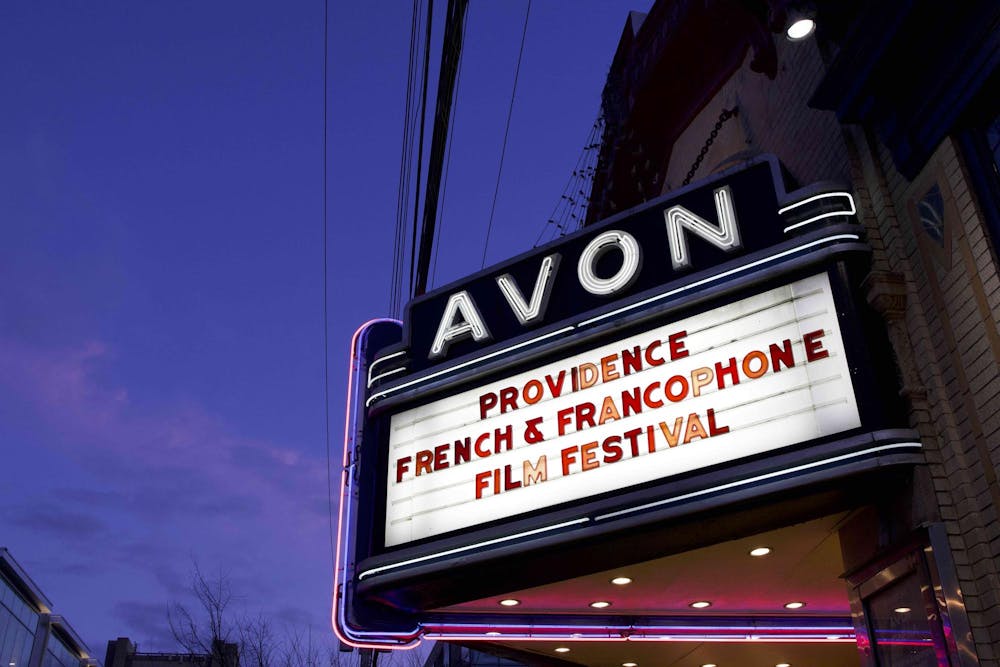
On March 12, the Avon Cinema looked a little different. Instead of its usual crowd, the theater bustled with students and Francophiles attending the opening night of this year’s Providence French and Francophone Film Festival. PFFFF will run until Thursday, showcasing a lineup of classic and contemporary Francophone films that span continents and decades.
Celebrating its 31st anniversary this year, the festival spotlighted the historic French New Wave — which is translated to “Nouvelle Vague” in French — the legendary aesthetic revolution of 60s French cinema.
Francisco Valente, the festival’s artistic director, explained that this year’s theme was chosen partly due to the recent success of Richard Linklater’s newest film, “Nouvelle Vague,” which was screened on Saturday night. The Golden Globe nominated-film pays tribute to Jean-Luc Godard and the filmmakers of the Cahiers du Cinema circle.
“So the film really pays tribute to that whole movement, that period, the aesthetic revolution of the Nouvelle Vague,” Valente said. The curators felt this year’s theme “would be the perfect opportunity to not only show (Linklater’s) film, but also some of the films that inspired it,” including the 1960 film “Breathless.”
The New Wave was also chosen as a theme in part due the movement’s enduring importance to cinema.
“Any time is a good time (to look at) the New Wave,” said Professor of French and Francophone Studies David Wills, who teaches FREN1150G: “New Wave Cinema from Paris to Hollywood,” a class on the movement.
“It’s one of the major examples in film history — of the last 125 years — where something very different happened and it took off,” Wills said. “It’s a moment when, 50 years into its history, cinema decided to renew itself.”
Valente added that the movement is about “youth, about creating something new, about building new images of the world,” Valente said. “That always resonates with new generations and older generations too.”
In addition to the classics, the festival also featured an array of contemporary cutting-edge films, including Hafsia Herzi’s “La Petite Dernière” — which won both the Queer Palm and best actress awards at the Cannes Film Festival — and the North American premiere of Abdellatif Kechiche’s “Mektoub, My Love: Canto Uno.”
Over the years, PFFFF has curated a diverse lineup of art-house independent films, documentaries, children’s films and high-budget blockbusters. “It has a very rich history with impeccable taste,” said Valente, who is a filmmaker himself and a film curatorial associate at the Museum of Modern Art in New York City.
The festival has humble origins. According to Krause, it grew out of a College Hill ciné-club, where Brown and Rhode Island School of Design faculty and graduate students gathered weekly on Sunday morning screenings to watch French films.
The event has come a long way since then. Krause emphasized the patchwork of community contributions that bring the festival together every year. “It’s a marvel to behold because there are so many little pieces and so many people stepping in,” she said, noting how many students and faculty are involved in the event’s planning.
Clara Beatty ’29 said she helped translate blurbs for each of the films in her class, FREN950A: “Advanced Written and Oral French: Traduction”
This collaborative spirit extends beyond Brown and RISD.
“The French-speaking community in Providence is fully engaged as well,” Krause said. The festival also partners with the French American School of Rhode Island, the Alliance Française of Providence and the French Consulate in Boston.
Attendees hailed from across New England. Krause said she also often gets messages from interested Rhode Island residents in the Alliance Française in Connecticut or the Alliance Française of Newport, among other organizations.
For Alexa Moses ’27, the festival has become a tradition. She has attended the PFFFF for all three of her years at Brown.
“I absolutely love the fact that such a large group of different people gather together for a shared appreciation and interest in French cinema.” Moses said after attending a screening of “La Venue de l’Avenir” on Sunday night. “I think that it’s very valuable to be perpetuating French culture here and also giving cultural access to the community.”
Krause also pointed to the broader cultural importance of celebrating foreign cinema and facilitating cross-cultural experiences. “It seems even more precious as we go forward, especially now in our current political climate, with this sort of nationalist mentality,” Krause said.
But the event also aims to offer “something that is artistic and joyful” that “brings us out of the woodwork,” she said. “We want to bring something to the community that brings us together.”
Rose Farman-Farma is a sophomore Comparative Literature concentrator from England who loves writing and music.


