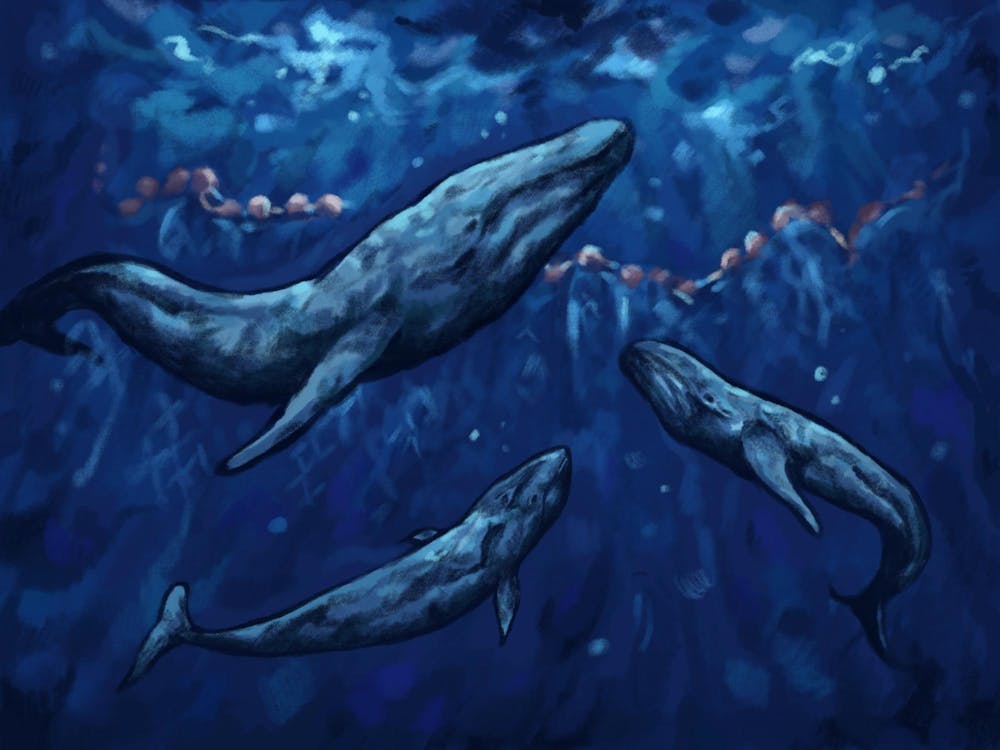
Last month, a blue whale was spotted off the coast in waters near Rhode Island by the New England Aquarium’s Anderson Cabot Center for Ocean Life — an “unusual occurrence,” according to a NEAQ press release. Within 24 hours, another survey documented two more.
“To see blue whales on back-to-back days is very unusual,” said Orla O’Brien ’10, a research scientist at the Cabot Center who conducted the aerial survey. “To see blue whales at all in New England waters is pretty unusual.”
The New England Aquarium estimates that only 400 to 600 blue whales — an endangered species in the northwest Atlantic — currently reside in this region. So, “the chances of seeing one of them on an aerial survey in a specific area on a given day is just very, very small,” O’Brien added.
According to the NEAQ press release, scientists with the Cabot Center spotted the first blue whale on Feb. 27 while flying over the Northeast Canyons and Seamounts Marine National Monument — a large protected underwater area off the coast of Cape Cod. The next day, the team spotted two more whales 15 miles south of Martha’s Vineyard and over 170 miles away from the first spotting.
“Seeing a blue whale is as exciting as heck,” Robert Kenney, an emeritus marine research scientist at the University of Rhode Island who helped manage data from the aerial survey, wrote in an email to The Herald. He noted that despite this sighting’s “unusual” geography, it’s not “unprecedented or all that surprising.”
“Blue whales go wherever they want to,” Kenney added. According to Kenney, blue whales are believed to spend the winter in deeper water farther from the coast, and they generally feed at higher latitudes.
During the Feb. 27 sighting, the researchers also identified three fin whales and three sperm whales — both endangered species — in addition to hundreds of other animals including dolphins, according to the NEAQ press release.
The press release noted that the sightings came a month after the Trump administration announced a rollback of protections for the Northeast Canyons and Seamounts Marine National Monument, which holds undersea mountains, deep-sea corals and a variety of endangered species unique to the region.
“Part of the goal of that survey is just to show that this is an area that should be protected because it hosts such a wide array of species,” O’Brien said.
She added that the NEAQ has conducted surveys in the area for roughly 15 years. Now that wind energy projects are operating in the area, “it’s also about collecting data” to identify any potential negative ramifications on whales from the turbines, she said.
But so far, “we don’t really have any specific things that we’ve seen that lead us to believe, anecdotally, that there’s this strong displacement” of whales from the area, O’Brien said. While there has been attention on wind farms as allegedly harming whales, there are “way more boats in the area, and boats are something that we know for a fact are dangerous for whales.”
According to Barbara Chapman P’18 P’20, a trustee and member of the litigation team for Green Oceans — a nonprofit that has opposed offshore wind developments off the coasts of Rhode Island and Massachusetts, citing ocean conservation concerns, raised legal issue with Brown’s research on anti-offshore wind groups and was “founded to help steer the energy transition away from harming the ocean,” according to their website — there has not been an environmental assessment conducted on the cumulative impact of all the area’s offshore wind projects that have been issued federal permits.
“You don’t have to be an expert to know that construction and operation of multiple offshore wind projects along the Atlantic whale migration routes and encompassing whale feeding grounds is potentially harmful to the survival of endangered whale species,” she wrote in an email to The Herald.
“There is no evidence linking offshore wind development to whale deaths,” state Rep. Seth Magaziner ’06 (D-R.I. 2) said in a statement emailed to The Herald. Magaziner noted that before offshore wind projects began construction, extensive reviews were undertaken to ensure projects off Rhode Island’s coast did not violate the Endangered Species Act.
O’Brien said that two proven threats to whales are entanglements with fishing gear and getting hit by ships.
“Getting rid of measures that are proven to be effective at helping whales survive is never going to be a positive thing for these animals,” she said.
The National Oceanic and Atmospheric Administration, with the National Marine Fisheries Service, recently announced “possible deregulatory action” on marine vessel speed limits originally put in place to protect certain whale species. The Trump administration also recently reversed bans on commercial fishing in the Atlantic ocean.
“Up and down the East Coast, there are a lot of entanglements of large whales in fishing gear,” O’Brien said. “Taking away protections from animals, especially in a monument, is not good.”
The White House and NOAA did not immediately respond to requests for comment.