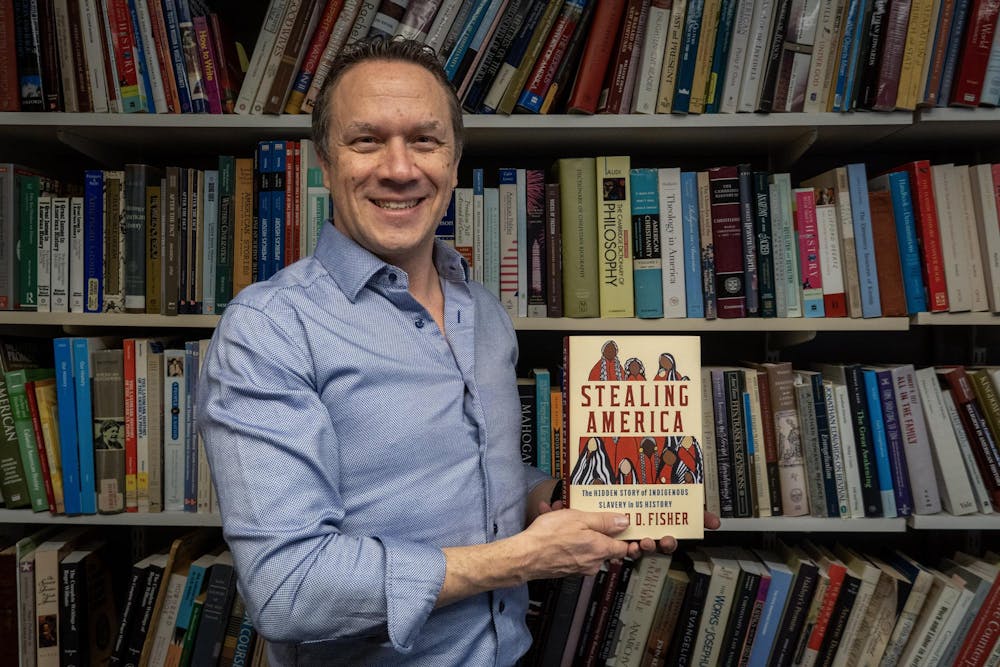
Almost 15 years after its conception, Associate Professor of History Linford Fisher’s new book, “Stealing America: The Hidden Story of Indigenous Slavery in U.S. History,” is set for release on April 28.
In the book — which covers nearly 500 years of Native history, from Christopher Columbus’s arrival in 1492 to the Indian Child Welfare Act of 1978 — Fisher explores the history of Native enslavement and its role in American history by centering the perspectives of Indigenous people.
“The history of slavery typically is told in terms of economics and labor, and production and exports,” Fisher told The Herald. But when consulting to Indigenous people, Fisher noticed that they defined slavery as the stealing of family members and loss of community.
“When you flip that perspective and think about communities, it's about people being taken away from them,” Fisher said. “One of the threads throughout the book is that we’ve maybe defined slavery too narrowly.”
Fisher’s work on the project started with considering New England’s connection to the Atlantic slave trade. Finding 18th-century church records of Native Americans listed as servants and slaves, Fisher wondered “where they came from.” But his research eventually led him across North America, from the East Coast to the Caribbean to California — and even to the United Kingdom’s National Archives.
Fisher leveraged existing relationships he had built through Stolen Relations, a project on the enslavement of Indigenous people he currently leads in collaboration with the Center for Digital Scholarship.
Fisher had some tribal members read the entire book and provide feedback. Paula Peters, a citizen of the Mashpee Wampanoag Tribe, said she appreciated Fisher’s focus on explaining the real contexts in which people were enslaved.
“(The book) is not just scholarly work. It's scholarly work that is done with heart,” Peters said. “He puts flesh on the bones of these ghosts of the past, and … he makes them real.”
Mack Scott, an assistant professor and director of undergraduate studies for the critical Native American and Indigenous studies concentration, also read a full draft of the book. He appreciated that Fisher’s work enables people to better understand where they come from. In his experience, Native people have resisted acknowledging their history of enslavement because of its link with the enslavement of Black people in the United States.
“In American society, any kind of blackening became a mark of degradation,” Scott said. “So there was an effort to separate those histories or separate that experience, but in doing that, we’re also separating ourselves from our ancestors that had to endure those realities.”
Fisher believes that incorporating Indigenous perspectives in his work is particularly important as a non-native individual researching Indigenous history.
“Doing this work as a settler, as a non-Indigenous person, especially, requires a lot of listening and humility,” Fisher explained. When approaching archives, he added, researchers must “ask really important and hard questions about whose voices are missing.”
Chase Bryer GS, a Ph.D. candidate at the School of Public Health and program coordinator for the Native American and Indigenous Studies Initiative, read a draft of Fisher’s book. “I feel like there are many historians and history books written without the perspectives of Native people, whose ancestors are discussed in detail,” Bryer said. “That’s really dangerous and can lead to erasure of cultures.”
As a citizen of the Chickasaw Nation, he expressed gratitude towards Fisher for “integrat(ing) himself in local, tribal community contexts.”
Fisher “played a really important leadership role in advancing our understanding in the broader field of people studying indigenous slavery,” said Karin Wulf, director of the John Carter Brown Library and a professor of history. “The book just kind of caps that.”
Fisher hopes the book inspires “individual researchers and graduate students in their local context to dig into local archives” to learn about Indigenous histories.
“We’re just scratching the surface,” Fisher added.
Correction: An earlier version of this article misstated the genre of Fisher's book. The Herald regrets the error.