
The last year has seen many Brown students speaking out about the issues they care about, from No Kings rallies to anti-ICE protests and outcries against the Trump administration. In 2026, activism remains a critical fiber in Brown’s social fabric.
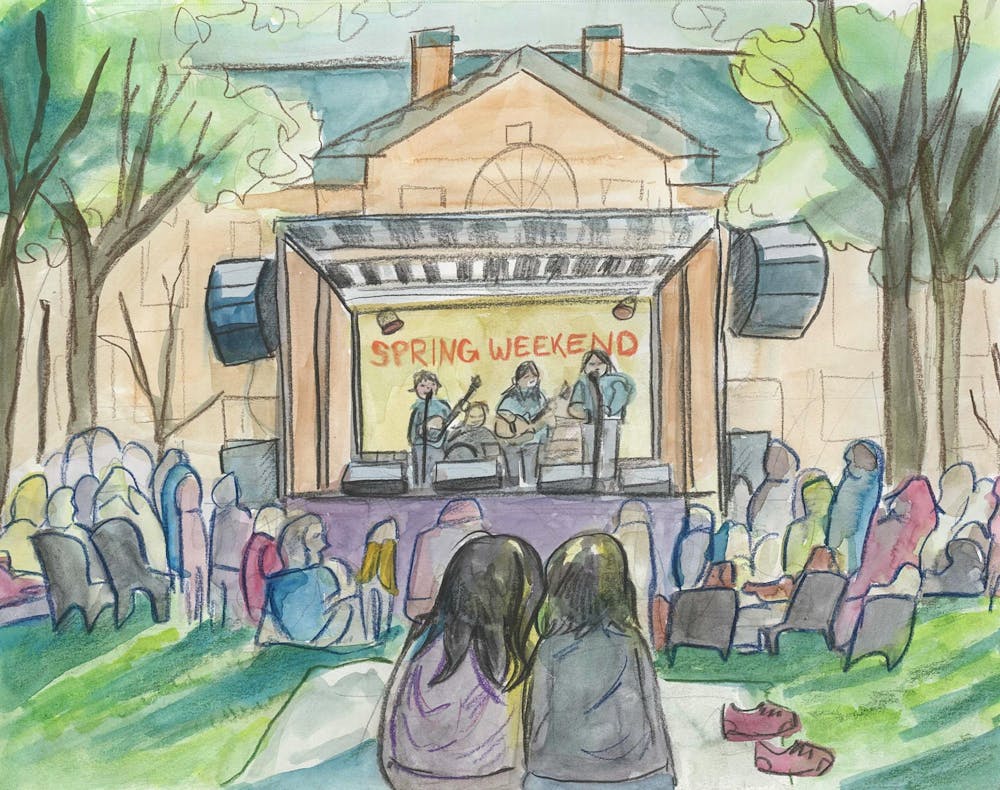
Thus, when engaging with this year’s Spring Weekend lineup, students should recognize the chance the festival provides for the Brown community to come together behind a collective voice in our country’s political discourse. Thee Sacred Souls, Magdalena Bay, BunnaB and Isabella Lovestory reflect a range of contemporary music, but their platforms also include care for their communities, support for grassroots activism, advocating for human rights and addressing issues with a political urgency. Hosting politically-engaged artists has shaped some of the festival’s most powerful historical moments — and can certainly shape Brown students’ perspectives on the world today. As students responding to Brown Concert Agency’s choices, we ought to remember that the artists selected should not only be reflective of what we like to listen to, but what we think deserves attention. Spring Weekend is not just a party, but an opportunity to raise the University’s collective social consciousness.
Spring Weekend has a history of often being a manifestation of Brown students’ political engagement. When singer and activist Dionne Warwick shared the stage with poet Allen Ginsberg, the BCA of 1968 effectively used their platform to amplify our community’s political priorities of racial justice and the anti-war movement. Spring Weekend had even hosted Martin Luther King Jr. just one year prior. In an era defined by youth activism, very much like that of today, performance and art were inseparable from protest and advocacy. A Spring Weekend guest in both 1964 and 1997, Bob Dylan acted as a megaphone for social reform everywhere. In 1997, he performed his song “Maggie’s Farm,” a protest against political conformity, with powerful lyrics like “Well, I try my best to be just like I am / But everybody wants you to be just like them / They say, ‘Sing while you slave’ and I just get bored / Ah, I ain't gonna work on Maggie's farm no more.”
And activist musicians aren’t a relic of a past era. There are artists who similarly reflect Brunonians’ political spirit, using their platforms to take political stances in 2026. In February, Puerto Rican artist Bad Bunny used his Grammy acceptance remarks to criticize inhumane immigration enforcement. Folk singer Jesse Welles is known for his protest music, such as his satirical song “Join ICE,” which has become something of an anthem for activists. And 1974 Spring Weekend performer Bruce Springsteen’s new song, “Streets of Minneapolis,” is a direct response to the killing of Renee Good and Alex Pretti, his lyrics echoing the vibrant protest music that backboned the 1960s. Our world and nation are still ripe with musicians who protest through performance.
Yes, political engagement on a campus as diverse and opinionated as Brown’s can be complicated. It might be easier to treat Spring Weekend simply as a chance to kick back, relax and forget about the stress of upcoming finals. In 2024, the BCA faced a torrent of backlash for their promotional poster’s design — which featured red, white and green colors that some students presumed were a reference to the colors of the Palestinian flag. But the BCA being political doesn’t have to create hostility — it can shed light on various perspectives in a way that doesn’t divide us, but instead engages us in a productive discourse. Confronting our differences may be a challenge at times, but it is one that is worth navigating to engage holistically with global issues. Just because difficult conversations might arise doesn’t mean they aren’t worth having. In fact, it emphasizes that they are.
While the University itself does not dictate the BCA’s Spring Weekend lineup, the sheer size of the festival’s budget makes it a significant investment and, therefore, an important reflection of our community’s values. The BCA has historically operated the largest budget of any student organization on campus — last year, the total cost of the concert reached around $680,000 — and it has a responsibility to do its part in continuing the University’s commitment to “Discussion Through Dialogue.” In 2024, in response to a student poll, the BCA chose to organize a one-day festival with higher-profile performers instead of a two-day festival with more artists. If we care so much about the prominence of the artists we put on stage, their engagement with pressing global issues should also have our attention.
The spirit of activism is largely synonymous with the spirit of Brunonia. We do not stray away from being active changemakers, and as we continue to speak out about the issues we care about, we, as students, should see Spring Weekend through a more socially conscious and political lens. All of this is not to say that we shouldn’t care about music for the sake of music. But maybe, while we enjoy dancing on the Main Green with our friends, we should think about what we’re dancing for.
Maya Tkachenko ’29 can be reached at maya_tkachenko@brown.edu. Please send responses to this column to letters@browndailyherald.com and other opinions to opinions@browndailyherald.com.


