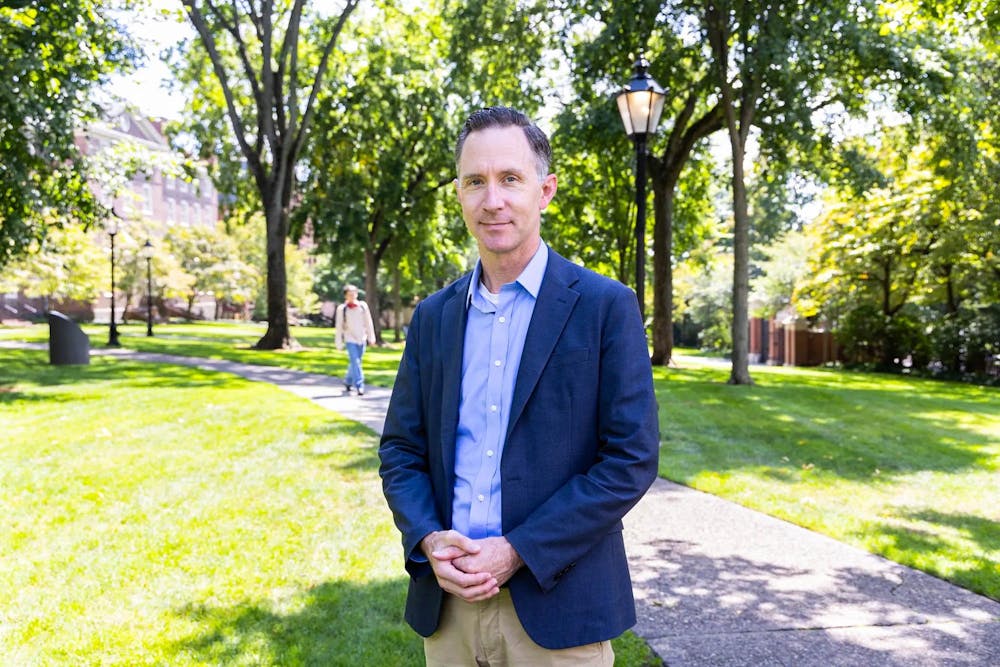
As a first-year student in college, James Kellner was “really terrified” to attend his first biology course, which was designated for students majoring in the field. Kellner was intending to major in political science.
“I remember calling my parents and telling them, ‘Don’t sell my bedroom furniture because I might be coming home again in the semester.’ My goal was just ‘don’t fail this class,’” said Kellner, now a professor of ecology, evolution and organismal biology and of environment and society, as well as the University’s inaugural associate provost for corporate engagement.
But as the class progressed Kellner “fell in love with biology.” Now a professor of the subject at Brown, Kellner has taken on another new interest: faculty collaboration with businesses and corporations.
According to Kellner, his new role aims to address three goals: “Cultivating relationships that increase and diversify research funding; developing new student internship opportunities and career opportunities; and deepening collaboration between Brown and organizations outside the university.”
Kellner became interested in the topic when some students asked him to be chief scientist for their remote sensing company. Before accepting the position, Kellner looked into University policy to ensure he was permitted to do so.
“It turns out we do have a policy that allows faculty to do this, and it’s in fact encouraged,” he said. Since then, Kellner has continued to work with the company, which he says has enhanced his work at Brown.
For Kellner, the purpose of corporate engagement on campus is to “benefit the University because you'll learn things. You’ll be exposed to ideas and ways of working that you can bring back to the University.”
For students, corporate partnerships can help them find internships or early career opportunities.
“There are a lot of people who want to know what they’re going to do when they leave Brown … and they are looking to the university to provide them with some help,” Kellner said. “I think we have some great programs that provide students with access to internships and employment, but growing that and deepening that can only be positive.”
Since the role is just in its infancy, Kellner’s past few months have been filled with outreach and building cross-campus connections.
Baylor Fox-Kemper, professor of earth, environmental and planetary sciences, reached out to Kellner when the new position was announced with an idea for “the perfect project to work as a prototype” for corporate engagement.
Fox-Kemper is part of the Socio-ecological Impact of Microplastics in Coastal Ecosystems research project, which aims to study the amount of microplastics in the Narragansett Bay. He hopes to work with corporations to assess the health risks of microplastics and how to reduce them.
Kellner has been working with various departments on projects in a range of fields, including the arts.
Sydney Skybetter, director of Brown Arts Institute, and associate professor of theatre arts and performance studies, had already been working on a robotics-industry-funded project that “puts robots and performers in the same space.” Since Kellner’s role was created, he and his team have served as a resource to support the BAI project.
“An arts institute has no natural front door into industry, and companies working on robotics and (artificial intelligence) have no obvious reason to think an arts institute would be a useful partner,” Skybetter wrote in an email to The Herald. “(Kellner’s) team has helped us think through where our work fits in the university’s broader relationships with those companies.”
The University has been working to establish a new Office of Corporate and Foundation Relations, which Kellner has been working with since assuming the role.
The office will aim to function “as a central hub for managing relationships with corporations, streamlining systems and expanding administrative capabilities and partnering with academic leadership,” wrote Sasha Dolgicer, executive director of the Office of Corporate and Foundation Relations.
Kellner has been working closely with Vice President for Research Greg Hirth, who is also a professor of earth, environmental and planetary sciences.
“We are working together to assess how our policies around these activities serve the dual purpose of encouraging our faculty to take advantage of such opportunities while also making sure we follow the appropriate guardrails for compliance,” Hirth wrote in an email to the Herald.
Seyla Fernandez is a senior staff writer covering faculty.