Last spring, Associate Teaching Professor of English Michael Stewart MA’07 counted 93 students in the crowd on the first day of ENGL 1050F: “Line Work: Experiments in Short-Form Writing” — a course with a maximum enrollment of just 17 students.
By reading through 59 writing samples, Stewart was eventually able to pare the crowd down to meet the course’s enrollment cap. But Stewart’s situation is not unique: He is just one of many professors who teach courses with high interest but low caps.
As students use these first two weeks to solidify their schedules for the remainder of the semester, professors are left with packed classrooms, delayed teaching schedules and a sense of uncertainty about the ultimate composition of their courses.
For Stewart, the overwhelming attendance during his first few lectures prevents him from providing his students with the attention the course requires. “Frankly,” he said in an interview with The Herald, he “can’t get much done the first class.”
Because of this, he tries to read through all submitted writing samples and solidify a final list by the first Monday of shopping period every semester.
Associate Teaching Professor of Biology William Holmes PhD’12 teaches BIOL 0220: “Discovering Novel Protein Folding Phenotypes of Wild Yeast,” a similarly small, yet competitive course. Like Stewart, he has also had to slow the pace at which he introduces content due to high attendance during shopping period.
When Holmes first began teaching BIOL 0220, he was surprised by student interest in the small course. In his first year teaching it, he introduced the course’s semester-long project by the second lecture. But he quickly realized that the cohort of students who showed up to his third lecture was completely different.
“I’m not exaggerating: Half of the class was probably new faces,” he told The Herald. He shared that this year, he plans to adjust his lessons to anticipate this flux in the first few lectures.
Unlike Stewart, Holmes’s final course list consists of the students who pre-registered for the class on Courses@Brown. But he noted that during registration in years past, BIOL 0220 has “filled up very quickly, to the point now where I might need to consider some secondary application.”
Shopping period is “a double-edged sword,” Holmes said. While it is a great opportunity for students, “there (are) a lot of logistics behind the scenes that we’re dealing with that make it really difficult.”
To narrow down the final course list for ENGL 1180Z: “Healthcare Journalism,” Assistant Teaching Professor of English Nell Lake MA’97 PhD’22 requires students to turn in a “breakfast story.” For the assignment, students must interview someone — starting with what they had for breakfast — and write a short article about them.
“You only do it if you really want to take the class,” she said. “Very few people turn in the assignment and then decide not to take the class.”
Assistant Professor of the Practice of English Ed Hardy doesn’t rely on applications for his section of ENGL 0930: “Introduction to Creative Nonfiction.” Rather, he leaves it up to chance.
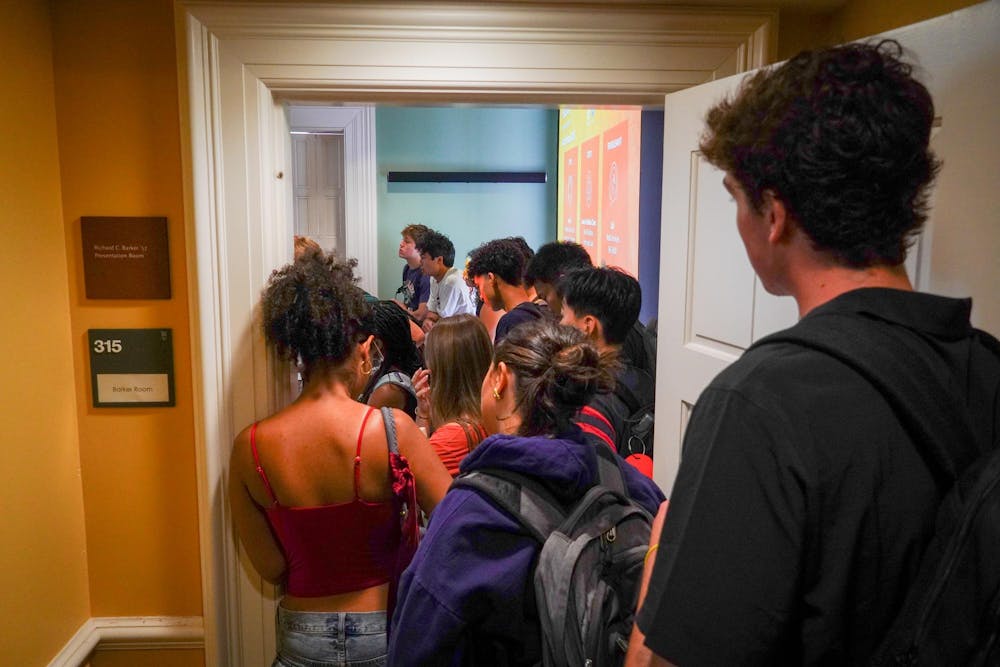
Hardy uses a lottery system to narrow down the enrollment for the course, which is also capped at 17 students. He said that anywhere from 35 to 55 students usually show up to his first lecture, making it difficult for these courses to take place in their designated classrooms — which are often small seminar rooms.
“One time I came in, and everyone had pushed all the tables to the edges, so everyone was sitting on the floor,” he recalled. “So I sat in the middle, and it felt like a campfire sing-along.”
But professors say having a large crowd of eager students during shopping period also excites them for the semester ahead.
“Enrollment matters to faculty’s job evaluations, especially for more contingent faculty,” Lake said.
She views shopping period as a “dog-and-pony show” in which she tries to “wow her audience,” she joked.
To convince students to ultimately enroll in his course, Holmes seeks to teach the class like one he would want to take.
Lizbeth Ruiz ’26 decided to stop by the first BIOL 0220 lecture on Thursday because she had taken a class with Holmes before. During shopping period, Ruiz prioritizes the “overall vibe of a professor” when selecting which classes to enroll in.
Jannah Maguire ’29, who shopped Hardy’s section on Wednesday, said she plans to enroll in courses that interest her, like those in which “people are really engaged and involved in the discussions.”
Since this is her first shopping period, Maguire is excited to “try a lot of different options,” she said. Although she plans on concentrating in chemical engineering, she shopped ENGL 0930 because of her love for writing.
Lake considers shopping period “a net gain practice,” but said that “it does create more labor and more flux in the beginning of the semester” for professors.
Hardy, too, believes that shopping period is generally “a good thing.” But he said it can also lure students into “an illusion of infinite choice.”

Alejandro Ruiz is a university news senior staff writer covering academics and advising. He is a junior from Edison, NJ studying biochemistry and philosophy. In his free time, he can be found with his friends or with an AirPod in.