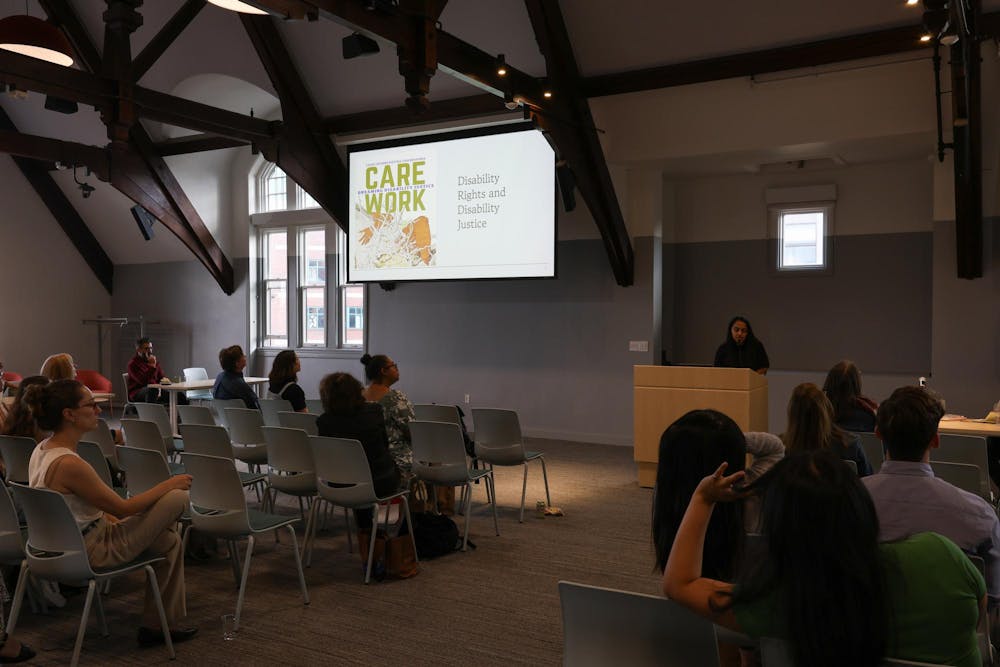
The Department of Anthropology held its annual fall research symposium this past Friday, spotlighting faculty, graduate and undergraduate research through a poster session and several panel discussions.
During the poster session, Adelaida Tamayo GS, a sixth-year PhD student in anthropology, presented her research on the role of art amid state violence in Colombia. Tamayo’s research examined embroidery, theater and music to explore how art empowers survivors to turn their grief into battles against injustice.
On her table, Tamayo showcased a collection of embroidery artwork by the sewing group Costuro Anarquista. Various photos depicting state violence in Colombia and Palestine were threaded together by string, representing how their “struggles are intertwined.”
While she was in Colombia, Tamayo worked with the mothers of victims of police violence. She also developed a documentary about those who had lost or had their vision injured due to police violence.
“We (thought) a lot about the idea of using art to expand testimonies and make audiences feel something together,” Tamayo said. “And I think that’s kind of the unifying topic … how grief can be mediated through expressive forms like embroidery, like music.”
Emerson Lee GS, a second-year anthropology PhD student, focuses his research on the use of minor language writing systems, such as traditional Mandarin Chinese, as subtitles in theaters.
Lee explained that movie theaters’ use of traditional Mandarin Chinese subtitles — script often preferred by Taiwanese audiences — has drawn backlash from viewers who find the traditional characters “disturbing and distracting when seeing a show.” On the other hand, advocates of the practice find that implementing traditional Mandarin subtitles helps to make the language more visible.
Lee derived inspiration for his research from his time working as an actor and director in Taiwan, where the issue of traditional Chinese subtitles really “disturbed” him.
At his table, Lee displayed a cardboard box with various quotes he had collected from interviews he conducted in Taiwan for his fieldwork. Some of the boxes read, “Don’t ban Taiwanese in Public” and “Mandarin is the fairest representation for all ethnic groups.”
Others also focused their research on the digital world, including a visiting fellow from Pakistan, PhD student Asad Javaid, who focuses his research on female Pakistani bloggers and how they try to “raise their voice” on social media.
“The focus will be on … how identity construction can be done with the help of blog-writing, and if there is any digital solidarity between the genders,” he said, adding that he decided on a multimodal approach as the blogs may also feature images as well.
Javaid added that he specifically decided to analyze blogs because “they are more focused towards personal opinions,” and his research focuses on whether the “construction of identity” of women is different from men.
Pedro Teixeira, a visiting scholar from the University of Coimbra in Portugal, told The Herald he looked forward to attending the symposium to understand the various anthropological traditions the research stems from.
Professor of Archaeology and Anthropology Peter Van Dommelen attended the event after speaking at the symposium last year, adding that it was a great way to meet new graduate students and faculty.
The greatest thing Tamayo has learned during this research is that with “topics like state violence, you have to fully commit your work to being complicit in the social movements that you are part of,” she said.

Claire Song is the managing editor of recruitment and audience for The Herald's 136th Editorial Board. She is a junior from California studying Applied Math-Biology. She likes to drink boba in her free time.