
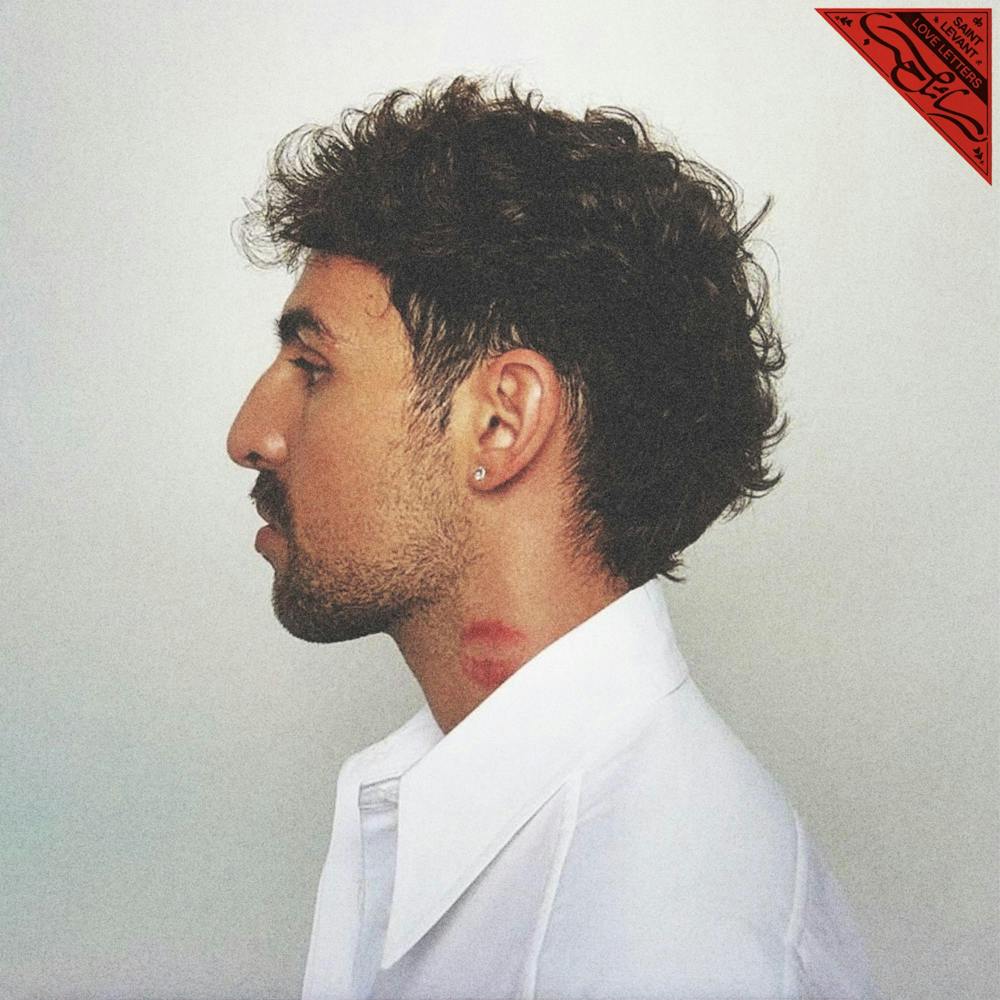
Saint Levant is closing out 2025 with a deluxe version of his album “Love Letters / رسائل حب,” originally released on Valentine’s Day. The record has been expanded to include four new songs, featuring new collaborations with creatives from across North Africa. Of Palestinian-Algerian-Serbian-French descent, Saint Levant brings romance to the forefront of his record: His love for his muse is expressed in the language of 21st-century internet trends and age-old cultural references.
Marwan Abdelhamid, known professionally as Saint Levant, is renowned for a discography that fuses cultures, languages and genres. His songs regularly feature lyrics in French, English and Arabic, a reflection of his multilingual and international upbringing. His music transcends the regional boundaries often foisted upon Arab creatives — his success in the Middle East coincides with his popularity among English-speaking audiences. The Instagram fan account “saintlevantworld,” which often posts translations of his lyrics, currently has 700,000 followers. Even though he draws heavily from Middle Eastern and North African music traditions, Saint Levant’s appeal is largely due to the universality of his music and its messaging.
The first new track, “NARI NARI NARI / ناري ناري ناري,” is a dynamic amalgamation of Saint Levant’s signature sound and lyricism. A celebration of Arab culture, Saint Levant highlights the experiences of many Arabs who reside outside of the Middle East and North Africa. When referencing the object of his affection, he playfully claims, in lyrics translated from Arabic, that “She speaks broken Arabic / Talk to me in plain English.” The track fuses prototypical American symbols — “fake tans” and matcha lattes — with mentions of Middle Eastern phrases and locations. His rap is interpolated with lively interludes.
The track is followed by “DO YOU LOVE ME? / سنيورة,” a much-anticipated collaboration with Egyptian singer Fares Sokar. The song includes features of Mahraganat, a subgenre of Egyptian music that blends rap, techno and R&B. The genre originated among working-class communities in Cairo and is often used to supply cultural commentary. Saint Levant brings Mahraganat to the second track, a song that celebrates the beauty of a beloved woman. Amid lively synths and a vibrant beat, he sings in Arabic — translated on the website Genius — that “Her figure is French (and what else?) / But her roots are Egyptian (and what else?) / Her beauty is unique / Nowhere else in the world.” Saint Levant’s lyrics broaden the reach of Arabic, speaking to the immigrant experience while foregrounding the language’s cultural relevancy.
“AYCHEK / عيشك” is deeply sensual, describing a toxic connection that Saint Levant can’t help but be wrapped up in. The track features a guest appearance from NORDO, a Tunisian creative who graced the cover of Billboard Arabia in May 2025. On the track, NORDO brings his signature vocals that play alongside strong drums and a pulsing bass.
The deluxe album closes with “SAMRA / سمرة,” a soulful ballad that laments the end of a past connection. The song sees Saint Levant at his best, his vocals shining on a track that hints at R&B influences. He’s accompanied by Babylone, an Algerian band known for singing in the Algerian dialect of Arabic, often referred to as Derja.
While the deluxe tracks are primarily sung in Arabic, Saint Levant and his collaborators also utilize English and French for their immersive lyricism that reflects the multiculturalism of “Love Letters / رسائل حب (Deluxe).”
In an interview with Billboard Arabia, Saint Levant acknowledged how he navigates singing in a number of languages. “From my very first song, I was using three languages because that’s just how I talk. The same goes for my music,” he said. “Now, I’ve learned to separate them more. Before, I used to mix all three languages in one sentence, but I realized not everyone is like me — they can’t follow that. So now, I do one chorus in English, one in Arabic and one in French, which makes it easier.”
For Saint Levant, his art is deeply interwoven with his activism. The 24-year-old singer recently took the stage at Wembley Arena alongside other stars for the “Together for Palestine” fundraiser, the proceeds of which were used to support Palestinian-led aid groups.
While, on the surface, the deluxe tracks are odes to the highs and lows of romance, his Palestinian identity is intertwined with his artistic presence. In “NARI NARI NARI / ناري ناري ناري,” the beautiful woman Saint Levant sings to in Arabic has skin “the color of olives” — a fruit that serves as a national symbol for Palestinians.
In “DALOONA / دلعونة,” the original album’s opening track, listeners receive an unflinching assertion: “They asked me, ‘Where are you from?’ / I told them, ‘I’m from Palestine.’ / I’m from the people of the mighty / And I hold my head high with pride,” translated from Arabic on Genius. Whether through the more overt messaging in the dance track “DALOONA / دلعونة” or the more subtle ones in the ballad “SAMRA / سمرة,” Saint Levant acknowledges his heritage in everything he does.
This artistic choice is not only centered around his Palestinian identity. In his song “EXILE / سمرة,” inspired by the sound of Algerian Raï music, Saint Levant uses both English and Arabic to articulate the pain of separation from a lover. Simultaneously, listeners are made aware of the horrors of displacement: The song’s orchestral climax is a culmination of shared pain and resilience. Meanwhile, the music video of his song “DIVA / بنت الذهبية” is a celebration of Algiers — the capital of Algeria — and the city’s historic beauty.
“Love Letters / رسائل حب (Deluxe)” is exactly that: a tribute to love in all its forms and its transformative qualities. For Saint Levant, romantic love is inextricable from the love he feels for his diverse cultural heritage. This celebration of diversity, in particular, platforms his Palestinian identity. Saint Levant brings to the mainstream the beauty of Palestinian culture, breaking down stereotypes and helping to preserve the identity for generations to come.

Alyssia Ouhocine is a Senior Staff Writer covering Arts & Culture. Hailing from Bayonne, New Jersey, she is concentrating in English and History with a particular interest in Algerian history and literature. When she’s not writing, she can be found listening to music and sending Google Calendar invites.


