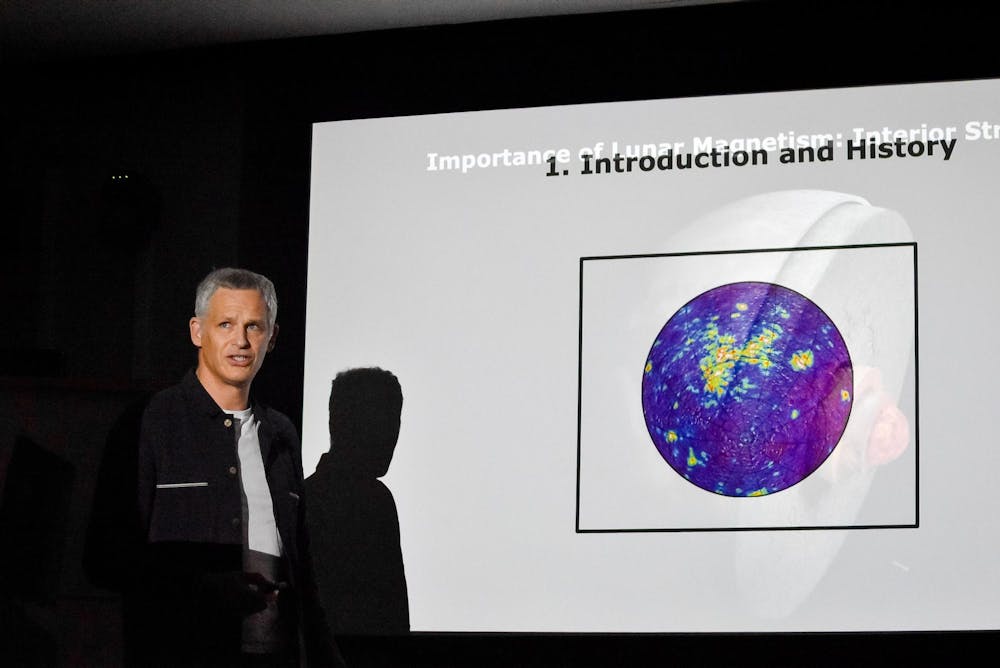
At a Thursday lecture event, Benjamin Weiss, a professor of Earth and planetary sciences at the Massachusetts Institute of Technology, spoke about his recent research on the lunar dynamo, which explains how a molten core helped form the moon’s now-dissipated magnetic field.
The lunar dynamo, specifically when it disappeared and its mechanism, has been a subject of scientific debate. At the lecture — a part of the Department of Earth, Environmental and Planetary Sciences’s Thomas A. Mutch Lecture series — Weiss argued the magnetic field dissipated as recently as 800 million years ago, which is over one billion years later than previous hypotheses.
Weiss analyzed samples from various Apollo missions to the moon and evaluated their “natural remanent magnetization,” which allowed researchers to determine the intensity of the ancient magnetic field. This allowed Weiss and his colleagues to show the dynamo existed much longer than previously thought.
He also argued core crystallization — a process by which a metallic lunar core crystallizes and creates the conditions necessary for the formation of a magnetic field — helped sustain this late lunar dynamo.
While others have proposed competing theories for the moon’s magnetic field, Weiss believes the theories do not explain the data from recent samples.
One of these hypotheses includes impact plasmas, which are generated from meteoroid impacts that could have potentially induced magnetic fields around the moon. But Weiss found the magnetic fields that would be produced via this alternative explanation are three orders of magnitude too weak to be consistent with the actual conditions of the moon’s magnetic field.
Weiss noted that precession — a process by which Earth’s gravitational field leads to movement in the moon’s core— cannot explain the date of the more recent Apollo samples.
He hypothesized that multiple mechanisms are most likely to be responsible for the lunar dynamo — with core crystallization generating a longer-lasting magnetic field after an earlier mechanism produced a shorter-lived, yet stronger field.
Justin Custado GS, a graduate student in DEEPS who studies climate issues on Earth, said he found the talk interesting because it differs from his own research focus.
It was “fascinating just hearing about their methods and how sensitive the measurements should be to gain an accurate representation of the magnetic field of the moon,” Custado said.
Attendee Nandita Kumari, a postdoctoral research associate conducting planetary and lunar research at Brown, said these findings can improve the understanding of lunar properties.
“It is very likely that the magnetic properties that we’ve seen on lunar surfaces are intrinsic to the moon and (are) driven by lunar dynamo overall,” she said.
Jonathan Kim is a senior staff writer covering Science and Research. He is a second-year student from Culver City, California planning to study Public Health or Health and Human Biology. In his free time, you can find him going for a run, working on the NYT crossword or following the Dodgers.