Assuming the role of national security advisor in 2001 and later becoming secretary of state in 2005, Condoleezza Rice spent eight years shaping American diplomacy. Those years were marked by the Sept. 11 attacks’ impact on American and global security, as well as increased military intervention and high-stakes negotiations in the Middle East.
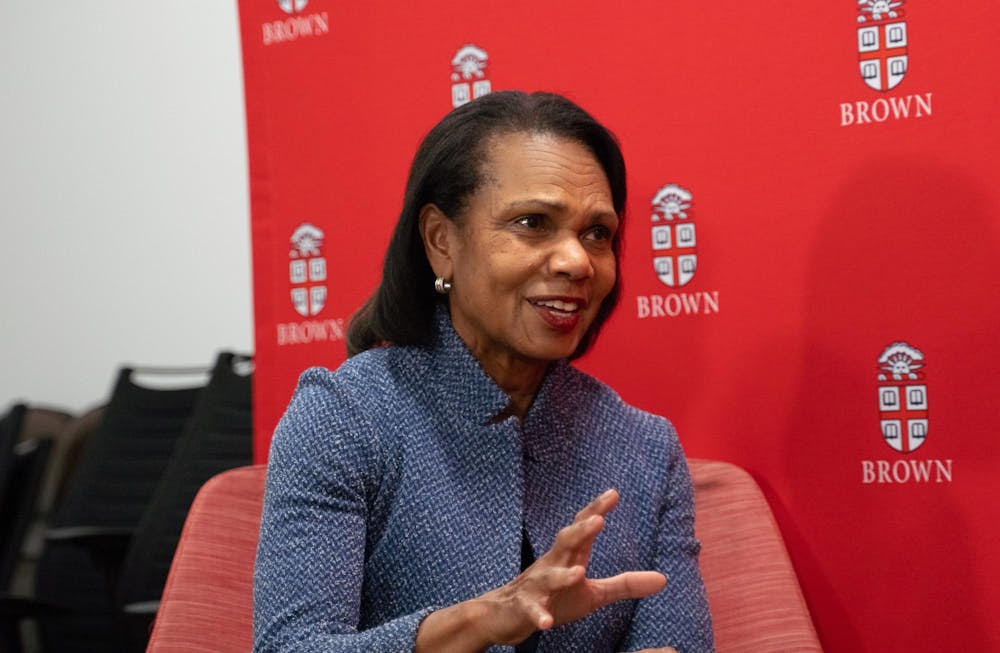
Now, over a decade after she left her post, Rice — the first female national security advisor and the first African American woman to become secretary of state — visited College Hill on Wednesday to speak at the 105th Stephen A. Ogden Jr. ’60 Memorial Lecture on International Affairs. There — and in an interview with The Herald prior to the event — she reflected on the current state of American diplomacy and provided insight on the obstacles that she says remain in fostering a shared international security.
Reflecting on Israel-Hamas, Russia-Ukraine wars
During the lecture, Rice spoke with President Christina Paxson P’19 P’MD’20 about a number of today’s most pressing foreign policy issues, including the Israel-Hamas and the Russia-Ukraine wars.
In the wake of the recent ceasefire agreement between Israel and Hamas, Rice said that “for the first time in a long time, we have a chance” to end the war.
As secretary of state, Rice was heavily involved in conflict mediations between Israel and the Palestinian territories and the larger Middle East region. In 2005, she worked to negotiate Israel’s withdrawal from the Gaza border, later assisting in negotiating a ceasefire agreement between Israel and Hezbollah in Lebanon the year after.
Despite her optimism toward a resolution of the conflict, Rice emphasized that both Israelis and Palestinians must take steps for peace, she argued at the lecture event. Israel needs to acknowledge the potential for Palestinian statehood, and the Palestinian people need a political authority to “take responsibility for Palestinian affairs,” she said.
“Bibi Netanyahu needs to say the words ‘Palestinian state,’” she added.
Rice also discussed the Russia-Ukraine War and the challenges of working with Russian President Vladimir Putin — a figure she said is key to ending the war.
“You couldn’t let him intimidate you,” she said during the lecture.
“I know you had my friend Hillary Clinton here,” Rice added, referencing the fellow former secretary of state’s visit to Brown last week. “She would tell you the same thing: He had two speeds — oppress and intimidate.”
At the event, Rice said she doesn’t foresee a monumental peace agreement ending the conflict. “I don’t think it’s going to be a big peace treaty,” she said in her talk. “It’ll just be a ceasefire at some point.”
“This war does need to end,” Rice said. “We just (have) to figure out a way to make Vladimir Putin understand it needs to end.”
When serving on former President George H.W. Bush’s National Security Council about five months before the collapse of the Soviet Union, Rice helped write the president’s 1991 “Chicken Kiev” speech. Delivered in Ukraine, the remarks cautioned against “suicidal nationalism” — reckless protest that can evoke a repressive response — and received backlash from Ukrainian nationalists.
Since then, Rice has been an ardent supporter of Ukraine — calling on the U.S. to provide more weapons and money to the country’s forces and advocating for admitting Ukraine to NATO.
When asked who she sees as America’s biggest foreign threat, Rice said China was the “broadest competitor,” citing the race over artificial intelligence.
“I want to make sure that on anything that’s really a breakthrough, we get there first, because we are going to have some bad things (that) are going to happen,” Rice said about the emerging technology.
“If there’s going to be a generally intelligent robot, I want her to speak English, not Chinese, because I trust us with that kind of technology,” she said, adding that the scrutiny of the press and congressional hearings will hold the tech companies making these innovations accountable.
Reflecting on her time in office
In an interview with The Herald, Rice reflected on her political career in the President George W. Bush’s administration.
After the Sept. 11 attacks, the United States “didn’t have a playbook” on countering terrorist attacks, she noted. At the time, the public often did not understand the administration’s decisions regarding the attacks and suspected terrorist activity in Afghanistan “in part because President Bush didn’t want the American people to worry about terrorism,” Rice told The Herald.
Following the attacks, the Bush administration authorized a military invasion of Afghanistan that attempted to overthrow the Taliban — a conservative Islamist political and militant group — and combat al-Qaeda, a transnational terrorist group. The intervention would last nearly two decades — becoming the United States’ longest war — while costing the U.S. tens of billions of dollars and killing tens of thousands of Americans and more than 100,000 Afghan troops and civilians.
During her tenure as national security advisor, Rice voiced support of the 2003 invasion of Iraq, defending the decision as necessary to counter a suspected weapons program under Saddam Hussein. It was later revealed that Iraq did not possess weapons of mass destruction.
During the event, Rice said that “the lives lost there will never be brought back, and for that, I still have regret.”
Various Democratic policymakers and civil rights groups criticized Rice for permitting the CIA to waterboard a suspected al-Qaeda terrorist, a move that potentially violated federal laws and the U.S. Constitution.
While in office, Rice faced a “difficult balance” between idealism and pragmatism, she said. “I think you have to always try to keep ideals at the center.”.
But “even if you have a set of goals out there, that a place like Afghanistan might have a chance of democracy, or a place like Iraq might have a chance of democracy,” there are daily practical decisions that need to be made for progress to occur, she added.
During her lecture, Rice said she believes “the world is better without Saddam Hussein.” She added that “Iraq is a fragile democracy, but nonetheless democracy, and I think if we can stand by them, that they may get it right.”
Almost two decades after its initial military invasion, the United States’ troops withdrew from Afghanistan in a monthslong process that ended in August 2021. Rice described the withdrawal from Afghanistan as “rather abrupt.”
“I think we lost patience with a country that we knew would have difficulty,” Rice added. Now that the U.S. has left Afghanistan, she is especially worried about “the state of women” in the country with the Taliban back in power.
Student activism and bridging political divides
For students who feel disillusioned by the current state of American diplomacy, Rice, who is a professor at Stanford, called on them to engage in public service through nonprofit work, working on a political campaign or joining a civic organization, like a Boys and Girls Club.
While Rice noted the role of student activism on college campuses, she emphasized that students should “make (their) activism about helping people who can’t help themselves.”
“It’s important for students to have views (and) opinions and try to act on them,” Rice said. “I always say to my students, before you try to solve that problem, try to know something about it.”
At the same time, she urged students to “talk to somebody who might think differently about the problem.”
When individuals “wall themselves off and only talk to people who have the same views that they do,” they neglect important democratic values, Rice said.
Universities can be an essential site for discourse across political lines, Rice said. She said that she is “proud” that universities, including Brown, have been sites for both students and administrations to “hear views that are different than their own” and “debate those views from a position of actual data and evidence.”
While political extremism has existed “throughout human history,” Rice believes bridges can be built one conversation at a time. “Our problem right now is that there aren’t enough people who are willing to cross those lines,” she said.
Students and community members reflect on Rice’s visit
With almost 80% of students on Brown’s campus identifying as very or somewhat liberal or progressive, Rice’s Republican political history contrasts with the dominant perspectives at Brown.
In an email to The Herald, University Spokesperson Brian Clark wrote that “welcoming a broad diversity of perspectives on our campus is fundamentally important to advancing our core mission of education and discovery.”
“Regardless of any attendee’s political ideology, there will be insights on democracy, the national political climate and international affairs,” Clark added.
Prior to her talk, Rice told The Herald she was “happy to engage” with an audience that may be divided about her political record and perspective, but encouraged students to “know what (they’re) talking about” first.
Daniel Solomon ’26, a member of the Brown Political Union, said Rice’s visit represents an opportunity to engage with a perspective he rarely encounters in the classroom.
“We owe her a great deal of respect,” Solomon added. “The whole concept of free inquiry is to listen to perspectives with which you may not agree.”
“I’m interested in understanding her perspective on some of our most pressing global challenges and how she views them in comparison to Secretary Clinton, through her different political lens,” Solomon said before the talk, referencing Clinton’s visit to Brown last week.
BPU member Gray Bittker ’27, an international and public affairs concentrator, saw Rice’s appearance as an opportunity to view U.S. foreign policy through the eyes of a practitioner who shaped it.
When universities platform politicians like Rice, “Brown has a dual mandate to allow the speaker to share their perspectives openly and also be challenged by the community,” Bittker wrote in an email to The Herald.
For AnnaLise Sandrich ’27, a writer for post- magazine, the event was a “cool opportunity” to hear from a political leader whose views differ from hers.
“There’s a lot of things that she has said … that I don’t agree with,” Sandrich told The Herald. “But at the same time, I think she does have a lot of insights.”
Antoinette Reed, a community member who lives on College Hill, was very impressed with Rice’s talk. Reed left feeling “optimistic” about the future of democracy, adding that Rice “didn’t grab at any political agenda.”
At the end of the day, Rice believes the core of democracy is “constant contestation.”
“That’s how we get to better policy,” Rice told The Herald. “That’s how we get to something that looks like the truth. And universities have a lot to do to make sure that that’s happening for our students.”
Maya Nelson is a university news and metro editor covering undergraduate student life as well as business and development. She’s studying English on the nonfiction track and loves to read sci-fi and fantasy in her free time. She also enjoys playing guitar, crocheting and spending an unreasonable amount of time on NYT Spelling Bee.