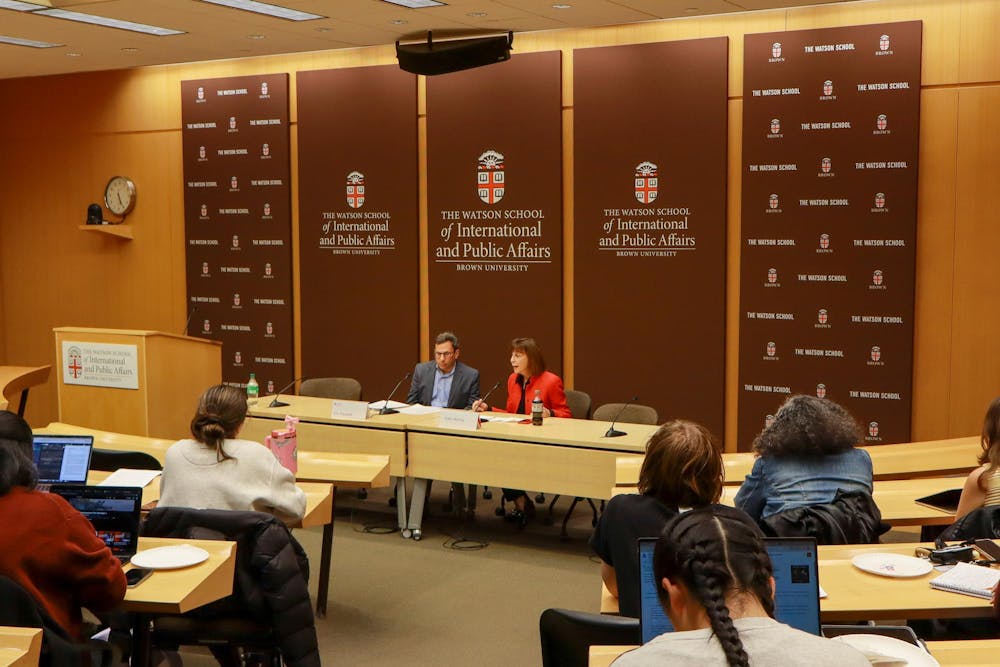
In a Monday conversation hosted by the Taubman Center for American Politics and Policy, former U.S. Rep. Kathy Manning, a senior fellow at the Watson School of International and Public Affairs, dissected the causes and symptoms of the ongoing federal government shutdown with Eric Patashnik, the center’s director and a professor of public policy and political science.
Manning, who represented North Carolina’s sixth congressional district from 2021 until 2025, explained that the shutdown began after the Republican-controlled Senate failed to pass a government funding bill by an Oct. 1 deadline. Now, more than a month later, the shutdown is the second-longest government shutdown in American history and Senate Republicans remain five votes short of the 60 required to pass a continuing resolution to keep the government funded.
The gridlock in Washington, D.C. largely stems from debates over Senate Republicans’ proposed bill, which, according to Manning, would allow “critically important” policies like the Affordable Care Act’s health insurance premium subsidies to expire.
One month into the shutdown, Manning warned that the U.S. Department of Agriculture’s funds for the federal Supplemental Nutrition Assistance Program, or SNAP, are “running out.”
The White House announced Monday that it would partially fund SNAP benefits, days after a federal judge ordered the Trump administration to tap contingency funds to support the program. These planned funds total about $4.65 billion, short of the program’s $8 billion monthly cost.
“We’re seeing a number of government offices and facilities that are not available to citizens (and) seeing constraints on funding and availability of benefits for crucial supports such as SNAP food stamps,” Patashnik told attendees. “And it’s a significant impact on millions of Americans.”
Manning also pointed to the shutdown’s impact on approximately “1.4 million federal workers,” who are either furloughed or working without pay.
Percy Unger ’26 said she attended the panel because she felt it was important to understand the repercussions of a shutdown affecting millions of Americans.
“I think whether or not I’m being impacted by the SNAP benefits being cut, many of my fellow Americans are being impacted,” she said. “I think it’s important to have a sense of the national climate on a personal level.”
But even if the two parties reach an agreement to fund the federal government, Patashnik said it remains uncertain if the Trump administration will distribute those funds as Congress intended.
Calling this the “million dollar question,” Manning argued that since January, Republicans in Congress “have completely failed to stand up to the President on almost everything.”
As the two parties trade blame for the ongoing shutdown, Manning said efforts to point the finger at the opposing party has resulted in “a messaging war.” This attempt to pin the blame on one side has only been compounded by misinformation, which Manning attributed to a “lack of credible news sources.”
Zoe Kaufman ’27, an event attendee and political science concentrator, emphasized that taking steps to understand the shutdown is “especially important” because of “a large problem of misinformation.”
“It’s so critical to decipher between all of the information that’s being thrown at you, much of which isn’t true,” she added.
In a separate interview with The Herald, Manning encouraged students “to go into the real world and see how policies can impact people who are struggling every day” while understanding “both sides” of the shutdown debate.
“Write letters to your members of Congress,” she added. “Write op-eds. Go meet with them if you have an opportunity to, and try to influence policy decisions in the right way.”

Alice Xie is a section editor for Science and Research from Los Angeles, California. She studies Applied Mathematics and Biology, and enjoys reading gut wrenching literature in her free time.