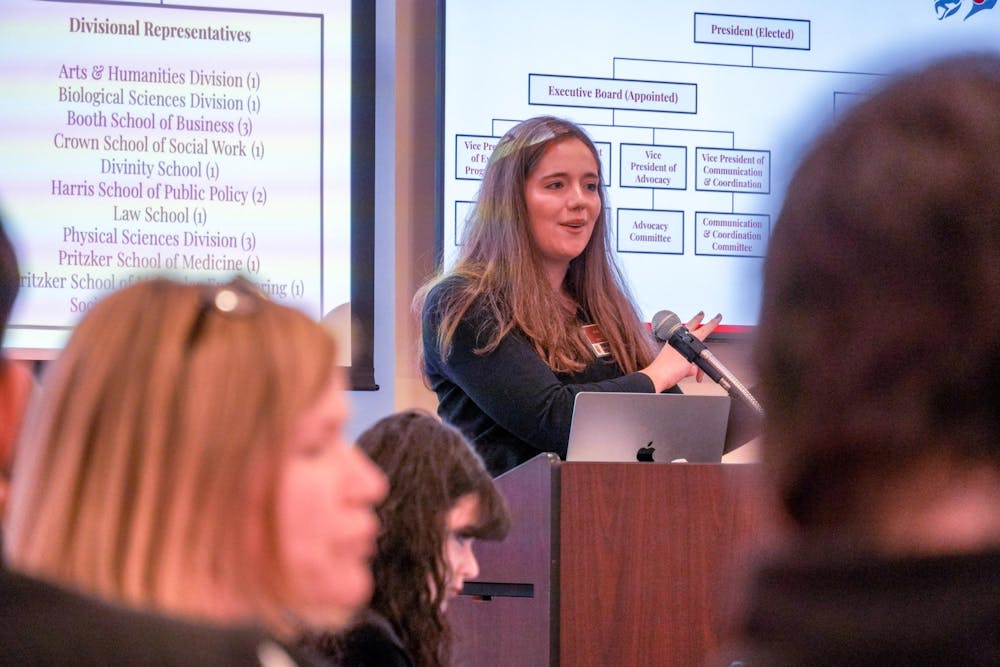
Each year, graduate student governments from every Ivy League school and other elite universities meet to share and brainstorm initiatives. This year, student representatives from all eight Ivies and the University of Chicago convened at Brown for the Ivy+ Summit from Oct. 24 to 26.
At each conference, the graduate student organizations discuss their current situations with the goal of taking back new ideas to implement at their own institutions. This year, these discussions explored how graduate student councils can navigate troubles with research funding and visas for graduate students in light of recent federal actions targeting universities. Student leaders also addressed pressing issues for graduate students, including housing shortages, food insecurity and access to child care.
The Herald spoke with leaders from four Ivy+ schools to discuss their takeaways following the summit.
At universities nationwide, the federal government has terminated or froze funding for some research initiatives. Several of the schools that attended the conference — including Penn, Columbia, Brown and, as of this week, Cornell — have reached deals with the federal government to restore some research funding while conceding to demands. But at the conference, many graduate students reported concerns about future federal actions.
Some schools, like Yale, reported grappling with an increase in endowment taxes after the “One Big Beautiful Bill Act” was passed this summer, said Saman Haddad, president of Yale’s Graduate and Professional Student Senate, in an interview with The Herald after the conference.
At the conference’s President’s Meeting, presidents of the schools’ graduate student governments discussed the possibility of creating a long-term action plan to protect against further federal encroachment, according to Ludwig Zhao, president of Penn’s Graduate and Professional Student Assembly.
But the schools, each having faced unique federal actions, were divided over how to approach the issue: Some leaders advocated for taking collective action, while others sought to lay low.
Attendees also discussed issues relating to graduate students’ financial and personal situations, such as how graduate student paychecks can affect decisions on having children.
Graduate students “have had to postpone having families, starting families (and) thinking about family planning,” said Nicholas Brennan, the president of the Cornell Graduate and Professional Student Assembly, in an interview with The Herald following the conference.
He noted that at the conference, “there was a lot of interest” in comparing each institution’s financial support offerings and “seeing how feasible it is to have a family” as a graduate student.
All of the institutions provide some form of financial support or benefits for graduate students with children. While some schools, like Harvard and Columbia, have their own daycare centers, Brown does not.
Graduate student leaders also noted the benefits of Anabel’s Grocery, Cornell’s student-run, nonprofit grocery store on campus that “keeps prices for necessity goods, like fresh produce, grains, milk and eggs … at or below supermarket prices,” Brennan told The Herald. Following the conference, Cornell’s Graduate and Professional Student Assembly voted to give the store an additional $40,000 in funding over the next two years.
The store “goes a long way to contributing to affordability,” he added, pointing toward Ithaca’s rising costs of living.
There was also discussion on expanding the Ivy+ meetings to include other schools — such as Duke University and Johns Hopkins University — to further strengthen collective action. But some schools, like Cornell, were reluctant.
“This is an important space, and I’m proud to be a part of it and to represent Cornell in it,” Brennan told The Herald. “But at the same time, as we think about looping in additional universities, we really need to come up with actionable items that speak to something larger than a statement.”
Kevin LoGiudice ScM’21 GS, president of Brown’s Graduate Student Council, told The Herald that the Ivy+ conference used to include other schools like Stanford University and Duke, but distance and meeting times made collaboration more difficult.
While the summit offered an opportunity for collaboration between the schools, most of the graduate student leaders told The Herald that the conference was too short to walk away with actionable items for the student governments.
After the conference, the schools took steps to more effectively share information through the creation of a shared Google Drive. The presidents now plan on incrementally adding information after their monthly virtual meetings to build a database, LoGiudice said after the conference.
“I would really like to see Ivy+ move in the direction of bringing everything together,” Brennan told The Herald. “I think there’s a lot of potential for growth.”

Ian Ritter is a university news and science & research editor, covering graduate schools and students. He is a junior concentrating in chemistry. When he isn’t at The Herald or exploding lab experiments, you can find him playing the clarinet or watching the Mets.

Emily Feil is a university news and metro editor covering staff & student labor and RISD. She is from Long Beach, NY and plans to concentrate in English and international & public affairs. In her free time, she can be found watching bad TV and reading good books.