Tucked away in a far-off corner of the Providence Public Library is the Updike Room. Visitors poking their heads in will immediately notice the large antique printing press filling the center of the space.
The press serves, in part, as the inspiration for a group art exhibition entitled “Turn the Page,” which opened in the Updike Room in early October and will be on display until Jan. 31.
Over a year and a half ago, Andre Bassuet, an adjunct lecturer in visual art, was at the library for a different art show when she stumbled upon the Updike Room and “fell in love with the space,” she told The Herald.
Bassuet was drawn to how half the room contained only empty bookshelves, inspiring her concept of a book art show. Bassuet played with the idea for a bit, and ultimately raised it with Sophia Ellis MA’22, then the PPL exhibitions manager.
For Bassuet, who curated the exhibit and teaches VISA 1240: “Art of the Book” at Brown, the whole exhibition was marked by a sense of collaboration that allowed everyone to appreciate their fellow artists.
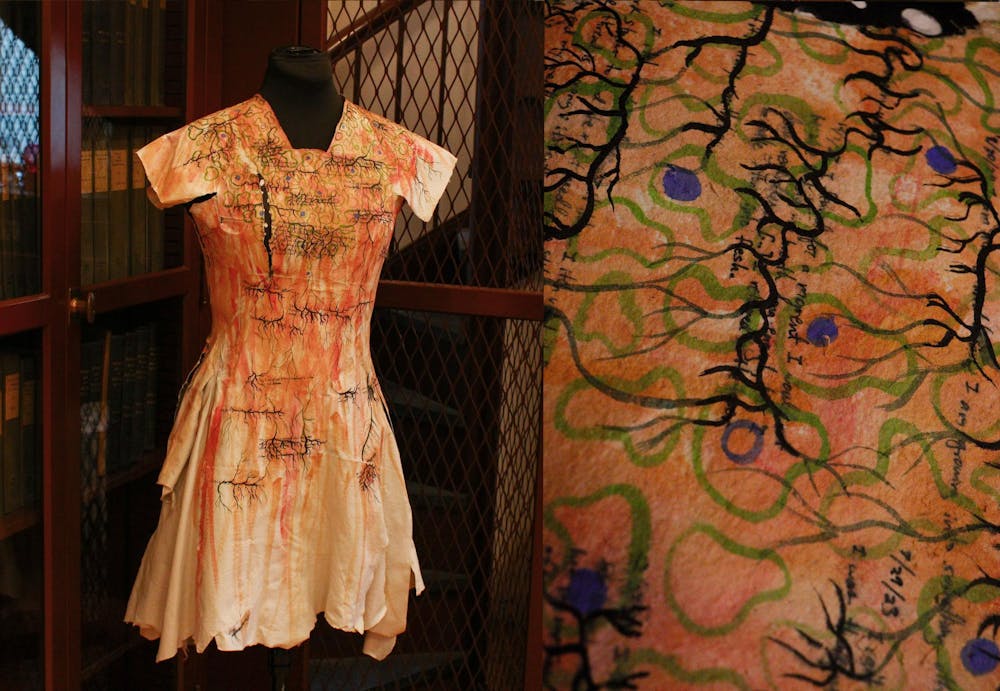
One artist, Iris Wright ’23, constructed a wearable dress out of a book for the exhibit. Wright, who uses xe, xem, xyr pronouns, told The Herald that xyr work was a continuation of xyr visual art honors thesis at Brown.
“I call these works ‘Book Bodies,’ because they are inspired by the book form. A book cannot be read or viewed in one image; its pages must be moved, its secrets revealed,” Wright wrote in an email to The Herald. “These wearable sculptures merge book arts and apparel design in a series of wearable, moveable works that use language and the gendered aesthetics of clothing to display the impossibility of accurately communicating the self.”
While working on this particular piece — titled “Book Body No. 7: Palimpsest” — Wright began exploring the idea of “censorship,” particularly in the context of book bans targeting “queer writers and queer stories.”
For Wright, “censorship in our present moment in the United States has felt like a shadow over my practice.” But Wright emphasized that queer people “exist and we see one another, and our government policing our language and narratives cannot make us disappear.”
“One way to defy censorship is to keep talking, keep making, keep congregating, keep sharing views that are being censored,” Wright added.
But not every artist turned the books into something entirely new. Michael Ezzell, a Providence-based artist, was asked to participate in the exhibit because of an ongoing series of pieces he’s created over the last decade, titled “The Junior Classic.”
All of the approximately 400 pieces he’s made for the entire series are “one-of-a-kind illustrations,” Ezzell explained. He has used antique and used book pages, and now, with this exhibition, deaccessioned library book pages.
Much of his work incorporates elements from Greek mythology, he added, and he tries to treat book pages as more of a sketchbook, where he can “get out a bunch of different ideas,” he told The Herald.
For this exhibition, Ezell worked with an etiquette book published around 75 years ago about how Southerners in the United States should behave.
“In today’s standards (the book is) so politically incorrect. And I just kind of thought it was really funny, because there (are) so many euphemisms in it,” Ezell said, adding that the book had entertaining chapter titles on menstruation and homosexuality.
Ezell explained that the exhibit feels “contrary” in a time when books are being banned, and antithetical to the history of burning books. A key difference between banning or burning books and making art out of them is the ability to give these texts a second life, he said.
“Even if you’re just taking the pages from the book to you and like to blend them up and use them as paper machine material, you are at least preserving the life of that pulp and that paper that was printed out at one time, and you are doing something else with it,” Ezell added.
Lara Henderson, who teaches at the University of Massachusetts Dartmouth, contributed several drawings on the pages of Anthony Trollope’s 1867 book “The Last Chronicle of Barset.”
Henderson said that this project was “a real eye-opening experience to me, of just how much paper comes from, one hard-copy book.”
Her practice as an artist often involves recycled materials “that would have ended up in the landfill,” Henderson said, noting that the exhibition was an opportunity to give “discarded books a second life and be in community with each other.”
Bassuet also created and displayed her own artwork in the exhibit. Bassuet said she is trying to make her art more “interactive” and figure out how to “engage the public.”
She added that her pieces were heavily influenced by the content of the books themselves. “I did spend the summer reading, reading, reading,” Bassuet said.
One of Bassuet’s pieces is titled the “Love Dispensary,” and visitors are invited to cut up bits of a book and make a black-out poem out of it. Phrases, according to her artist statement, can be either “positive or salacious.”
Another of Bassuet’s pieces, titled “Women in the Field,” is a floor-length cape made of pages from Marcia Myers Bonta’s book of the same name. To create the piece, Bassuet used cyanotype and embroidery. She chose to create a cape because it “symbolizes heroism, virtue and courage,” her artist statement reads.
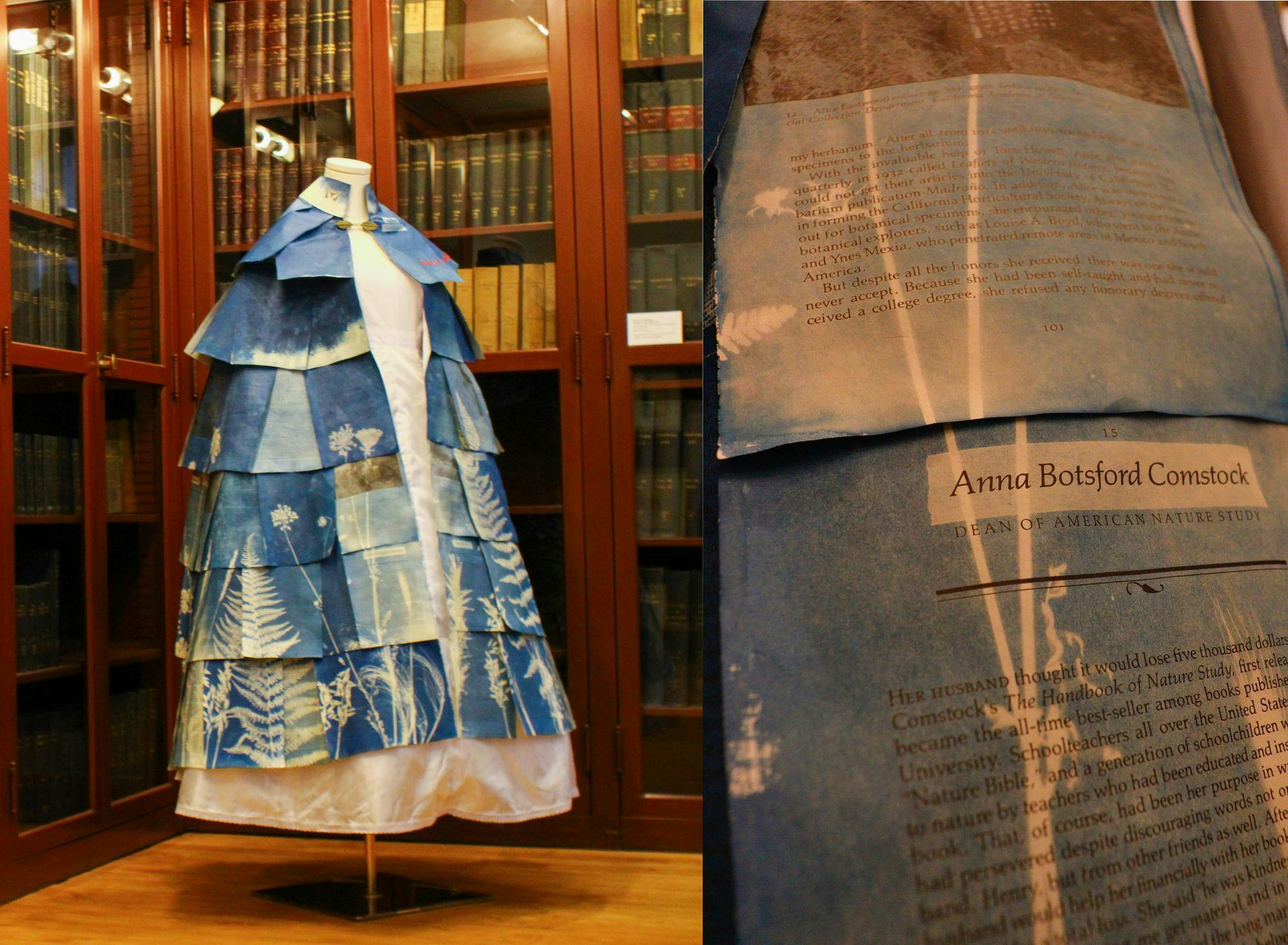
Andre Lee Bassuet's cyanotype and embroidered garment titled "Women in the Field." The piece is a floor-length cape made of pages from Marcia Myers Bonta’s book of the same name.
The book was made up of “chapters of women pioneers that were working in male-dominated fields,” Bassuet said. Bonta’s book includes biographies of 25 women who were all involved in naturalism, or the study of the outdoors, in the late 18th through early 20th centuries.
“These are women that had it even more difficult than we have now,” she said. But “they were able to do all this research and pave the way.”
Bassuet added that “those stories of resilience and struggle just really resonated with (her),” noting that she “didn’t want all these names to be forgotten.”

Talia LeVine is a section editor covering arts and culture. They study Political Science and Visual Art with a focus on photography. In their free time, they can be found drinking copious amounts of coffee.