
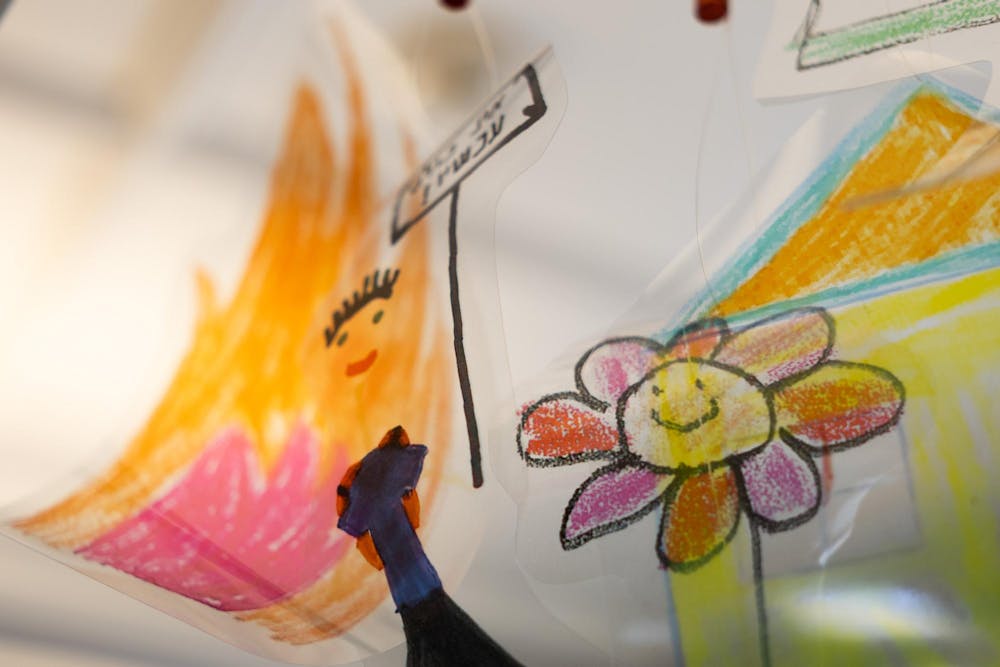
Between October 2024 and June 2025, curators collected digital images of nearly 400 drawings from children in communities across Israel, East Jerusalem, the West Bank and the Gaza Strip as part of a project called “Innocent Knowledge.” Sixty-two of those pieces are on view in the Ruth J. Simmons Center for the Study of Slavery and Justice until Feb. 20.
The idea for the exhibition emerged in the fall of 2024 from the seminar MES 1051: “Israel-Palestine: Public Humanities” when Associate Teaching Professor of Judaic Studies Katharina Galor, the course’s instructor, asked students to think beyond the classroom.
“The task was to come up with a way to conceptualize a project in the visual or performing arts that would engage both Israeli and Palestinian societies,” Galor said. “The past and present are entangled in a way that one cannot understand the reality without engaging both sides.”
Canaan Estes ’28 spent a gap year in Israel before coming to Brown. Estes, who is Jewish, was in Israel when Hamas killed over 1,200 people on Oct. 7, 2023. Inspired by “I Never Saw Another Butterfly,” a collection of poetry and art by children imprisoned in the Theresienstadt/Terezin concentration camp, Estes proposed the idea for “Innocent Knowledge.”
Taher Vahanvaty ’27, another student in the seminar, also helped develop the project. Having lived in Jordan for much of his life — which hosts a large Palestinian population — Vahanvaty felt familiar with perspectives shared by many Palestinian people.
“I think I understood for a long time that they felt unheard,” Vahanvaty said.
The project took off after Galor contacted an educator in Gaza who worked directly with children about the project. After receiving the first batch of drawings, Galor said that “everybody was completely overwhelmed.”
But expanding the project brought complications.
“The most difficult (part) was to get people on board,” Galor said. “Because one of the things we made very clear from the outset was that (the project) involved children from both sides.” For some, it was “out of the question to participate in a project that included the enemy” while others worried about their safety.
Despite these challenges, the curators received drawings by 393 children.
“We tried to identify the most interesting and the most representative drawings of all the communities” to display in the exhibit, said Galor.
The curators organized the works into six categories they deemed “relevant to all the communities” included, Galor said. Next, they mixed all of the drawings together, prompting viewers to look at the images without immediately attaching geography or identity.
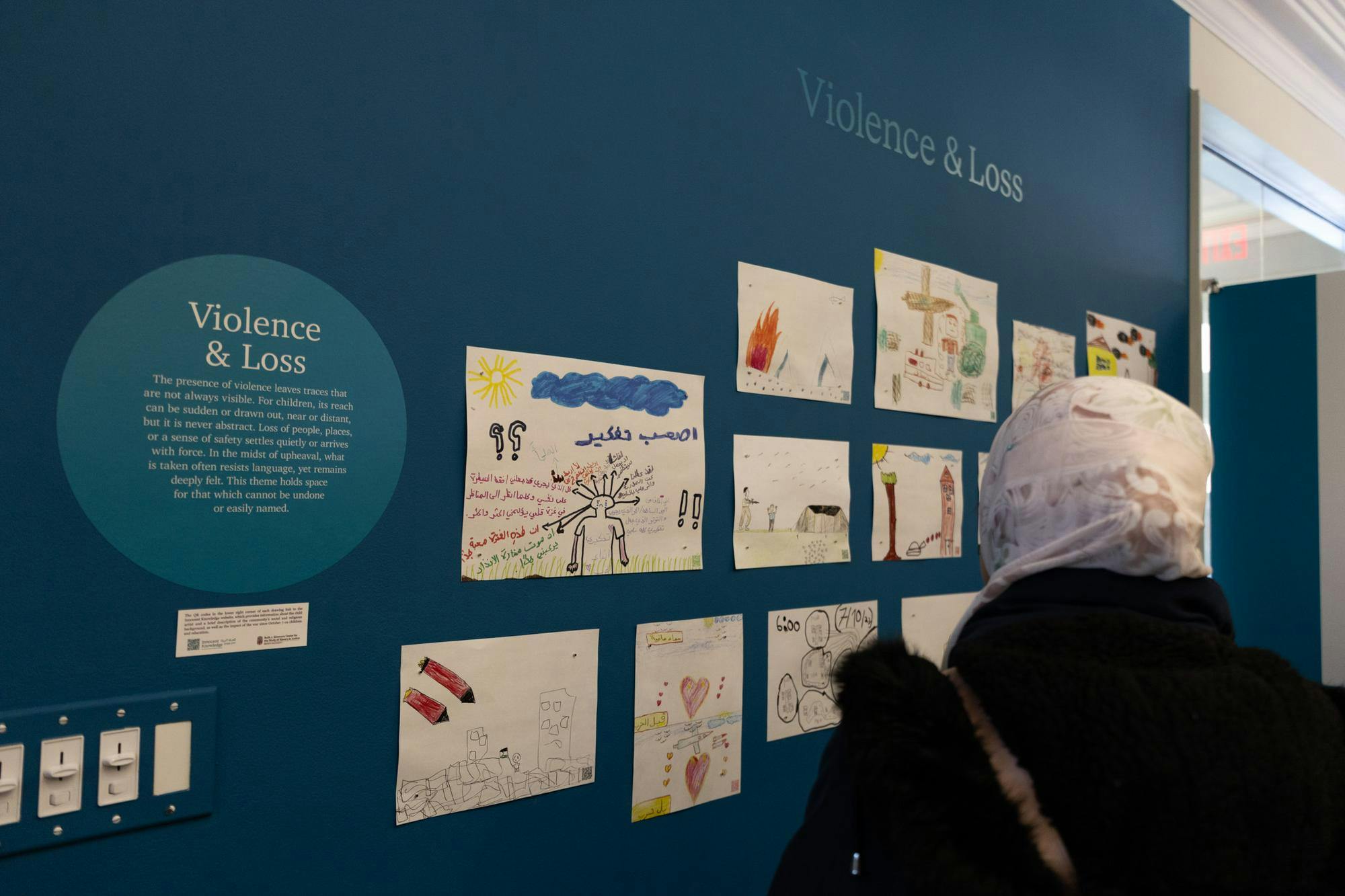
Each drawing has a QR code that identifies the artist’s age, gender and, when available, details where they are from. The emphasis of the exhibit, though, is on seeing “the child and the humanity of the child,” Galor said.
“I think these drawings speak for themselves,” Estes said. “They communicate just the sheer violence and terrible experiences that no child — no one — should have to be subjected to.”
A drawing from a girl in Herzliya, Israel depicts two hands reaching out to each other, one with a large heart stamped onto the fingers, and a dove holding a purple heart in its beak. Another drawing, from a child in a refugee center in the West Bank, depicts an individual frowning in a house and a Palestinian flag above.
“There’s also something that they also all share, and it's being children and being the ultimate victims of what’s happening in the region,” Galor said. “Without putting it into words or adult language, they express how they feel, how they dream, how they imagine, what they observe through images,” she added.
For Anthony Bogues, professor of humanities and Africana studies and inaugural director of the Simmons Center, the drawings are an extension of the hope that human life has to offer.
“Once there is human life, I always think that there’s hope for better.” he said.
“In the midst of death, the midst of maiming, the midst of war,” Bogues said, “for kids to have hope is an extraordinary thing.”
Timothy Ro is a senior staff writer covering arts and culture.


