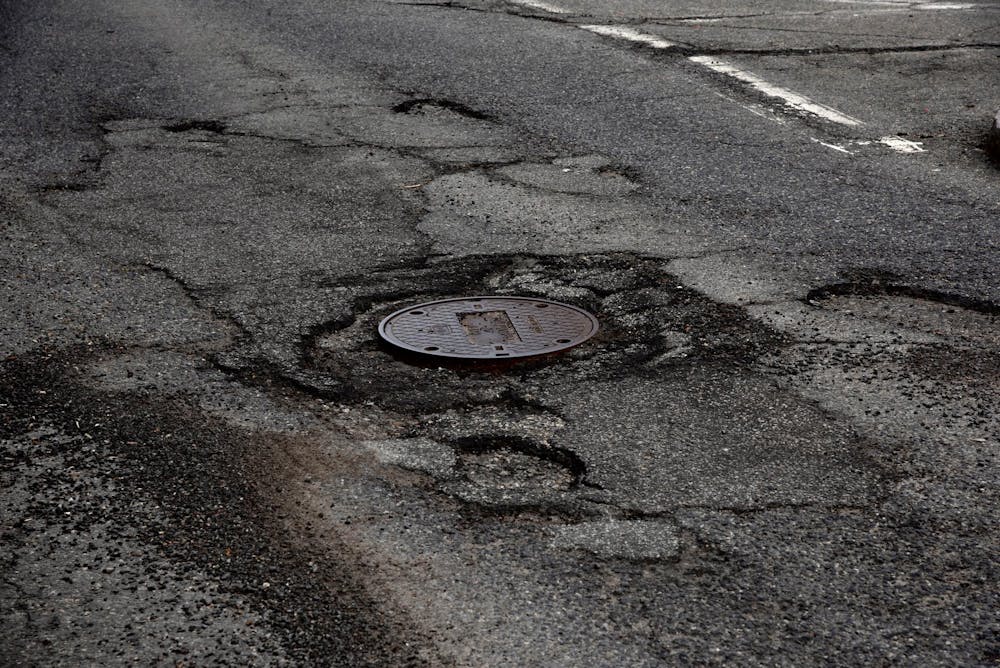
Rhode Island is on the cusp of spring. Though the snow is almost melted, the end of winter leaves behind a renewed stumbling block for drivers: potholes.
The Rhode Island Department of Transportation has seen 414 potholes reported on state roads so far this year — in the same period last year, the agency saw just 212, according to RIDOT spokesperson Charles St. Martin.
Providence has also received 426 pothole reports this year, which City spokesperson Josh Estrella attributed to “historic snowfalls.”
The City has five crews focused on fixing potholes, Estrella wrote. As of March 19, Providence has filled 700 potholes since the February blizzard — including new reports and existing damage.
Data gathered from Federal Highway Administration Reports found that 32% of Rhode Island’s state roads are classified as being “in poor condition” according to the International Roughness Index. Many of these damaged streets are high-capacity, high-speed “urban principal arterials.”
These streets are harder to fix than other road types, according to Teaching Professor of Environment and Society Kurt Teichert.
“Much of the highway and bridge maintenance work is done overnight when traffic flows are reduced and lanes are shut down for long periods,” he wrote in an email to The Herald. “It is much more difficult to take an arterial offline for a significant amount of time.”
More potholes have formed this year due to a “combination of the plowing from the blizzard and warm temperatures of late,” St. Martin wrote. “Last winter was far milder.”
New England is particularly prone to “freeze/thaw cycles,” in which “water seeps into the pavement, freezes and expands,” St. Martin wrote. When “traffic drives over these areas,” potholes are created.
The January snowstorm — which brought roughly a foot of snow to Rhode Island — “is likely responsible for many of the potholes opening up,” Teichert wrote. “Then the fast melt of the blizzard snow expanded the issue.”
Each day, RIDOT dispatches crews to patrol state roads and patch existing potholes. When Rhode Islanders report potholes, they are “immediately entered into our work order system” for repair, St. Martin wrote.
He added that their work is assisted by the “pothole killer,” a vehicle with an attached mechanical arm that sprays air to clear debris from the crater. The pothole is then sealed with a “liquid asphalt emulsion” to produce “a very durable, long-last patch.”
According to St. Martin, the crews’ work is impeded by snowy and rainy weather. Asphalt is sensitive to cold temperatures, and asphalt plants are typically not open in cold weather, he wrote, which “limits the amount of durable patching material” available. RIDOT works to schedule pothole operations if asphalt plants do open temporarily in winter.
As a result, crews often resort to a “cold patch,” wrote St. Martin. According to RIDOT’s website, cold fills are a less durable and temporary remedy. This year, the agency is “making greater use of a product called Perma-Patch,” an asphalt-repair mixture, “which is more durable than standard cold patch,” St. Martin added.
Last year, the city of Providence acquired new equipment that has sped up the pothole repair process, Estrella wrote. Providence crews use special trucks to keep asphalt hot so that potholes can be filled without crews needing to constantly refill their trucks.
Piles of snow left by the blizzard have made driving through potholes especially difficult for some Rhode Islanders. With Providence streets significantly narrowed, Alyson Panzloff ’27 said she was forced to drive through potholes to avoid hitting a car in the oncoming lane.
Her large SUV cushions her from the impact of most bumps and jolts, but crossing through potholes feels “like my tire is gonna get stuck in the road and explode,” Panzloff wrote in an email to the Herald. “There’s no way to swerve and avoid (potholes) most of the time,” she added.
Kaelyn Haselhorst ’28 noted that even before the blizzard, potholes in Providence were worse than towns in other states she had driven through.
In August, “I drove my car up from Austin, Texas to Rhode Island, and I drove through so many states,” she said. “Providence is, for sure, the roughest one so far, even more than Boston.”
WPRI recently released a Target 12 report that found Rhode Island has ranked last in state road conditions for at least 10 years, according to data gathered from the Federal Highway Administration.
In 2016, the state launched “Rhode Works,” its 10-year plan to revamp the infrastructure such as roads and bridges. Since then, RIDOT has “improved 2,000 lane miles of road with brand new paving,” St. Martin said.
“For decades prior to RhodeWorks, roads were not well maintained,” he added. “Because of that, oftentimes we cannot just repave a road. We need to dig down to the subpavement, address drainage and other stormwater abatement issues, and make sure the new road is (Americans with Disabilities Act) compliant.”
Through RIDOT’s ongoing $500 million five-year pavement investment, the state hopes to have “better riding surfaces and fewer potholes” in future years, wrote St. Martin. Additionally, Gov. Dan McKee’s RhodeRestore program has invested $140 million in efforts to pave local city and town roads.
For now, drivers will have to brace themselves for the impact. “When you’re driving up, and you see that one is suddenly actually way deeper than you realize, your car’s life flashes before your eyes,” said Haselhort. “You just have to keep staying alert.”
Ava Rahman is a senior staff writer covering housing, infrastructure and transportation.