On Saturday, TEDxRISD, the Rhode Island School of Design’s chapter of TEDx, hosted five speakers as part of their 2026 conference centered around the theme “Desire Path.”
The theme of each conference goes through multiple rounds of voting and discussion, according to Julian Rodriguez, a RISD senior and co-president of TEDxRISD. Desire paths are “paths that are worn through human interaction, not designed or paved or built roads,” Rodriguez explained, and represent the choice to “carve your own way.”
Emma Kuo, a RISD junior and TEDxRISD co-president, said the theme’s versatility had the added benefit of allowing the team to showcase their artistic skills when marketing. “We really got creative with the paths and the colors, and I think that was really representative of what a RISD student team can do,” she said.
Kuo said that the organization prioritized selecting speakers who “had to overcome challenges to get to the academic or personal point that they are at right now.”
Wendy Tang, a RISD senior studying industrial design, opened the event with her talk “Touching Death is How I Face My Fear.” As the founder of the RISD Taxidermy Club, Tang discussed how the art of taxidermy helped her understand life after her Type 1 Diabetes diagnosis.
“I kept touching dead animals, not because I was obsessed with death, but because I was trying to understand what being alive actually means,” she said during her talk.
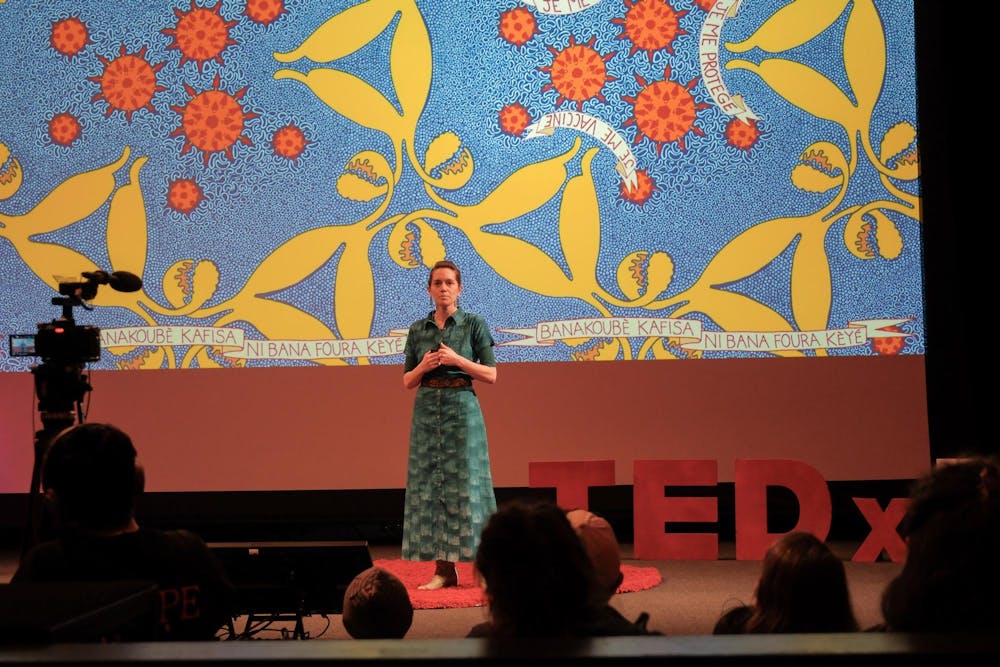
Eliza Squibb — a RISD alum, industrial design critic at RISD and lecturer at MIT — spoke about her experiences using textile patterns to bridge the worlds of art and science in her talk, “Social Fabric.”
Over the past decade, Squibb has created textile patterns as communication tools for populations that face inequities in accessing healthcare. In her talk, she pointed to a recent project: a fabric printed with a visual calendar with infant and childhood vaccinations that could be worn as a baby wrap. The project would support mothers with low literacy levels, who may not be able to use traditional calendars.
“My goal is to always give people health information in ways that (are) empowering and not stigmatizing,” Squibb told The Herald.
Chanya Vitayakul, who graduated from RISD in 2025 with a graphic design degree, discussed the difficulty of breaking silence and articulating complex experiences through art in “When The Body Becomes Public.”
Vitayakul shared how their experience getting an abortion informs their art and taught them to value truth.“I don’t treat the idea of a desire path as a metaphor, but as something I have to enact repeatedly in order to stay alive, self-defined and connected to my own body,” they said in their talk.
In “Invisible Paths: How Encounters Shape Life,” Felipe Shibuya — an assistant professor of experimental and foundation studies and history, philosophy and the social studies at RISD— spoke about his work at the “intersection of art, design and biology.”
In his experience teaching biology to art students, he has found that “the classroom turns into an ecosystem where desire paths emerge between disciplines, between ways of knowing and between forms of responsibility,” he said in his talk.
He encouraged the audience to acknowledge their role as participants of nature by paying attention to the world around them.
Raveena Deshpande, an architecture master’s student at RISD, gave the final talk of the night.
In “The Subtle Power of Small Things,” she discussed her experience working with a nomadic hunting community that had been forced to settle, emphasizing the importance of communication to understand what the community truly needed.
When Deshpande and her team arrived in the community, they learned that the roofs of their homes were made with a material that “washed away” every monsoon season. While the team initially wanted to create a grand design for a housing project, they realized the best solution for the community was to simply “fold” the roofs to create A-frame style homes that could better handle the weather.
“Sometimes (design possibilities) just need to be thoughtful, because the most impactful architecture I worked on wasn’t big. It didn’t make a statement,” Deshpande said in her talk. “It just folded a roof.”
In an interview with The Herald, Deshpande said she hoped the audience left her talk knowing “that sometimes it’s enough to do little things, if they are thoughtful enough. They will bring about the change you hope, if your intentions are clear and you understand the problem deeply.”
Kuo said that she was “proud” of the TEDxRISD team for putting together the event. “There was a lot of power that came from each individual,” she said.
“Allowing others to find the beauty in sharing stories and being able to communicate them across such a unique medium here at RISD … is just something that I am ready to do year after year,” Rodriguez said. “Really, it brings me purpose, passion.”
Izabella Piatkowski is a senior staff writer covering the Rhode Island School of Design.