
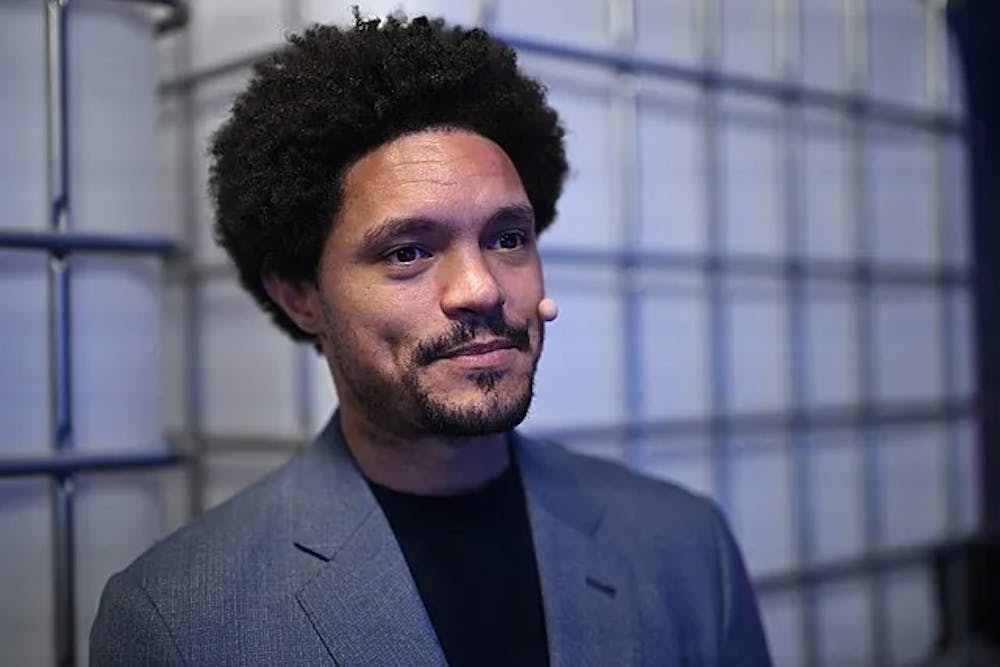
Trevor Noah wears many hats — actor, political commentator, Emmy-award winning television host, producer, New York Times bestselling author and, of course, comedian. But it is when he combines these pursuits that his work shines brightest.
This is particularly evident in his latest Netflix special, “Trevor Noah: Joy in the Trenches,” which is as entertaining as it is politically salient. Filled with rich storytelling, Noah’s special invites viewers to appreciate the comedy within chaos.
The special, released April 14, opens with a drone shot of Washington, D.C. and Noah saying “what an interesting time it's been.” He then transitions into an anecdote explaining how Trump’s threats to sue Noah for a joke he made while hosting the 2026 Grammy Awards derailed his initial plans for the special.
Noah delivers this thought-provoking story in a way that isn’t a mood-killer, instead his light-hearted tone invites viewers to laugh at something as serious as threats of free speech litigation. In doing this, he develops an undercurrent of comfort for viewers who are living through uncertain times.
“When you read history, or when we’re taught history, it is often presented as if it was inevitable,” he says. “When you’re in history, it’s a completely different gambit.”
Throughout the set, Noah puts a comedic spin on what otherwise would just be flat-out depressing — like when he discusses a hypothetical alien invasion on Earth, but concludes that the aliens would determine the planet had already been invaded after meeting Trump.
At one point, Noah uses a conversation he overheard during a visit to the National Museum of African American History and Culture as a framework for commenting on one’s role in history. “Who will you be when history calls?” he asks.
He attempts to answer this question over his next few anecdotes, expressing concern that he is not as brave as those who fought against oppressors before him. In one story, Noah manages to use a hilarious conversation with his white, liberal friend to make a stinging point about the imagined return of slavery.
He also uses this segment to aptly critique how schools teach students about Martin Luther King Jr., arguing that they do so in a way that reduces his story to something “like a Disney movie” where the plot feels “really simple and inevitable.”
All of this profundity, told through comical stories and impressions, culminates with Noah’s conclusion that “just because the big is happening doesn’t mean the small stops.” He then explores the conflict of celebrating personal successes in the midst of national crises — a dichotomy that Noah presents as an inevitable struggle.
“In every hospital around the world, there’s a ward where a baby has just been born and another where somebody has just died,” Noah said.
He then describes World War I soldiers who managed to find moments of happiness during the war. Through this historical anecdote, he asserts that finding small joys “in the trenches” is crucial so that people can remember “what they are fighting for.”
The closing anecdote of the set is when Noah, after discussing modern conflicts and relating them to historical ones, zooms into his personal life and recounts a therapy session. His therapist told him he was undateable, particularly since he doesn’t seem to think before he speak.
Noah’s ability to laugh at his own love life is, like the rest of the performance, evidence of his capacity to find humor amid hardship — whether it’s in his dating life or being hated by the president of the United States.
Millie Barter is a senior staff writer covering RISD.


