
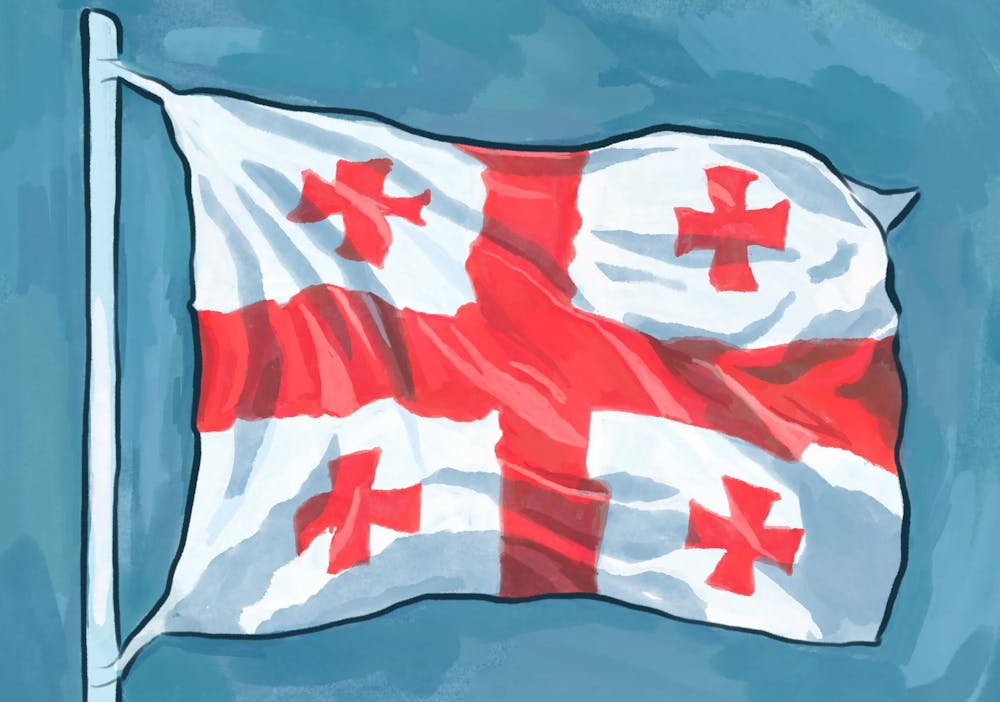
On May 22, I was listening to music at the wryly named 1984 Jazz Club in Tbilisi, Georgia when I learned that President Trump had attempted to revoke Harvard’s ability to enroll international students. Five months later, Georgia’s government introduced a similar restriction on its own universities.
I was in Georgia to study human rights and democratic backsliding under the country’s increasingly autocratic government. What I did not expect is that these lessons would also become relevant at home.
Following Brown’s successful restoration of federal funding in July and rejection of the Trump administration’s compact in October, it’s easy to feel like the risk to Brown’s intellectual integrity has passed. But in our assessment of the future, Brown ought to recognize the jarring parallels between the Georgian university reforms and the challenges faced by the Brown administration during the first year of the Trump administration.
The small, post-Soviet state was on the path toward liberal democracy when it was diverted by the 2012 arrival of Bidzina Ivanishvili, a billionaire businessman whose far-right Georgian Dream party has governed the country ever since. In October, the party announced a systemic restructuring of its national university system, which critics have described as a “purge” of dissent and a direct encroachment upon institutional independence.
Authoritarianism does not bloom in a bubble. As attacks on universities are normalized in one country, they become easier to justify in another. GD’s assault on Georgia’s universities looks like it was inspired by government encroachment on higher education around the world, including the Trump administration’s crackdown on universities in the United States. This begets a scary cycle: As governments watch each other test the limits of institutional independence, they can borrow each other’s tactics.
At the heart of the Georgian reforms is the new “one city, one faculty” policy, which sequesters individual fields of study to individual cities in the country. By decentralizing universities and pushing the nation’s youth from the capital, which has historically also been the center of zealous anti-government protests, the government dilutes its primary opposition. Ilia State University Professor Hans Gutbrod has warned that the government would be able to relocate any social studies field — for example, scholars of political science who may oppose the government — exclusively to a remote campus high in the mountains. Ilia State, a GD adversary that is located in Tbilisi, faced a dismantling of its humanities programs, and its undergraduate intake was slashed from 3,828 to just 300 students.
GD seeks to consolidate power by eradicating Georgia of independent voices. I saw it for myself: While studying there, I learned from professors who were barred from lecture space, had a class cancelled when the professor was suddenly exiled from the country and had another surveilled by a government agent. That doesn’t happen in the United States. But this past year has seen the creation of a culture that scares people out of speaking out.
Already, GD borrows from Trump’s vocabulary. The government justified October’s reforms by accusing Georgian universities of corruption, overenrollment of foreign students and inefficiency. Last spring, Brown faced funding cuts and congressional investigations due to accusations of antisemitism, discrimination and harassment, mismanagement of funds and “collusive pricing practices.”
In July, the University signed a voluntary agreement to restore withheld government funding. This agreement did not grant the federal government any direct oversight over Brown’s operation. However, it did establish a framework of ongoing federal monitoring of the University and set a dangerous precedent for the future of the federal government’s relationship with our school.
It did not take long for the risk of this precedent to materialize. In October, Brown was issued an invitation to join the “Compact for Academic Excellence in Higher Education,” in which the administration offered greater access to funding, federal contracts, visas and tax benefits in exchange for intrusive federal oversight and standards for curriculum and campus ideological composition. Two weeks later in Georgia, GD gave itself oversight of the hiring and compensation of university faculty and the selection of research priorities.
While the University, commendably, rejected the Compact, its very existence revealed how the federal government feels they can control Brown. This is because, as in Georgia, the government holds a powerful bargaining tool over universities: access to funding. As long as this is true, Brown’s institutional independence will likely continue to be tested by the Trump administration.
These tests, moreover, are likely to continue to reflect those imposed on Georgian universities: For example, the Trump administration asked Brown to eliminate diversity efforts in the July agreement, and GD demanded government oversight over student allocation to different degree programs. For another example, the Trump administration asked Brown to limit enrollment of international students in the October compact, and GD demanded that universities cease admitting them entirely. Again, Trump’s October compact asked Brown to “(abolish) institutional units that (act) against conservative ideas.” GD’s reform commits universities to “national academic and developmental goals.”
As a university, we celebrated our institutional and ideological independence with the decision to reject the October compact. But the federal government still holds the purse strings, and if we are not vigilant in protecting our independence and ideals, we may face the same fate as Georgian universities. For Brown to continue to lead the world in “a spirit of free inquiry,” we need to advocate against impingements upon intellectual independence around the world. While President Christina Paxson P’19 P’MD’20 has done a commendable job protecting the University’s interests so far, Georgia should be a warning sign and a reminder not to forget what we’re fighting for.
The changes occurring in Georgian higher education may feel extreme compared to those thrust upon our institutions in the United States. But Georgia shows us the dangers college students face when living under a government willing to compromise the independence of universities. Being a Brown student today means living at the whim of a mercurial government with the ability to silence incubators of dissidence.
Isabella Gardiner ’28 can be reached at isabella_gardiner@brown.edu. Please send responses to this column to letters@browndailyherald.com and other opinions to opinions@browndailyherald.com.
Isabella Gardiner is an opinions editor and a member of the editorial page board. She is a sophomore from London, UK, and plans on concentrating in history.


