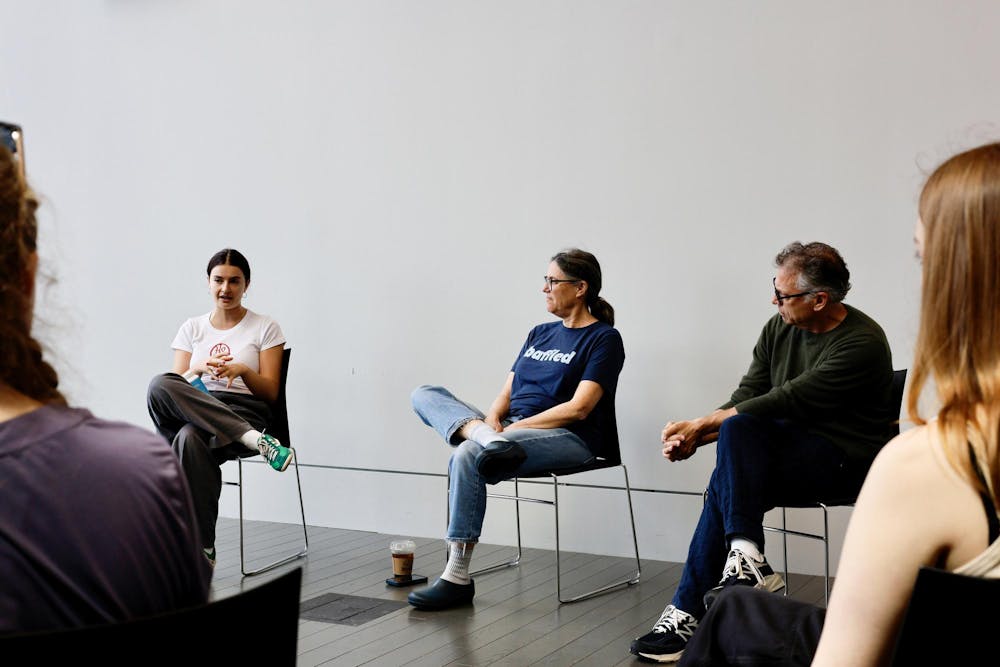
At the Brown Art Institute’s most recent installment of its “Hollywood Creators” series in collaboration with the Department of Literary Arts, director and producer Talia Light Rake offered an actionable take on breaking into the film industry: The first step to success is simply putting yourself out there.
Light Rake has produced content for the Sundance Film Festival, Tribeca Film Festival and New York Fashion Week, and wrote and directed a TV pilot in collaboration with Ashley Iaconetti and Jared Haibon, known from their time on “Bachelor in Paradise.”
During the talk, she described her nonlinear, nontraditional route into the indie film scene — one that included cold emails and making connections in unexpected places. For example, Light Rake recalled the time when she raised nearly $90,000 for a film by reaching out to strangers online.
Through that experience, Light Rake learned that “people are investing in you more than they’re investing in the project,” she said.
While prior generations of filmmakers relied on festivals like Sundance to launch their careers, Light Rake believes a “social media renaissance” is reshaping the industry, allowing new audiences to be reached.
Platforms like Instagram and TikTok can function as “a business card for getting things going,” she said, adding that they offer a way to attract collaborators and hone one’s creative identity.
But early in one’s career, discomfort can stem from projects feeling insufficient soon after completion, Light Rake said. She referenced a quote from Ira Glass ’82, saying that, when one first starts their career, “your talent has yet to meet your taste.” She explained that while early-career creatives can recognize quality work, they might not yet feel like they have the skills to replicate it adequately.
Despite this uneasiness, Light Rake believes that this early-stage work is an important part of artistic development, and she advocated for early-career creators to focus on speed over perfection. Shortening the time between creation and release allows artists to learn faster and detach from the pressure of a single project, she said.
“How you’re able to learn is by doing,” she said. “So if you’re able to constantly be making things, then you’re able to be less precious (and) comfortable with saying ‘onto the next.’”
Light Rake extended this philosophy to her critique of traditional career paths. While many young creatives may pursue assistant roles in the entertainment industry, Light Rake warns that these positions can come at the cost of personal output.
Her alternative is demanding, yet succinct: “You have to do everything.”
Instead of focusing on a single role, Light Rake explained that continuing to build a portfolio and networking are important to establish oneself in the industry. “You always need to be making things, so you have something to show for the thing that you want to be,” she said.
Light Rake also rejected the idea that success requires certainty. “Try everything. You don’t know what you’re best at, also, until you’ve done it and tried it and failed,” she said. Still, employers will often look for people who fit a specific niche, so Light Rake advised that “you lead with the thing that you want people to be excited about, and then be really f— good at everything.”
While the traditional film industry promises legitimacy through repeated institutional validation, Light Rake said that navigating the modern world requires embracing instability. To her, getting one’s name out there — whether it’s through iPhone shoots, cold emails or unlikely connections — is the key to success in the film industry.
Timothy Ro is a senior staff writer covering arts and culture.